


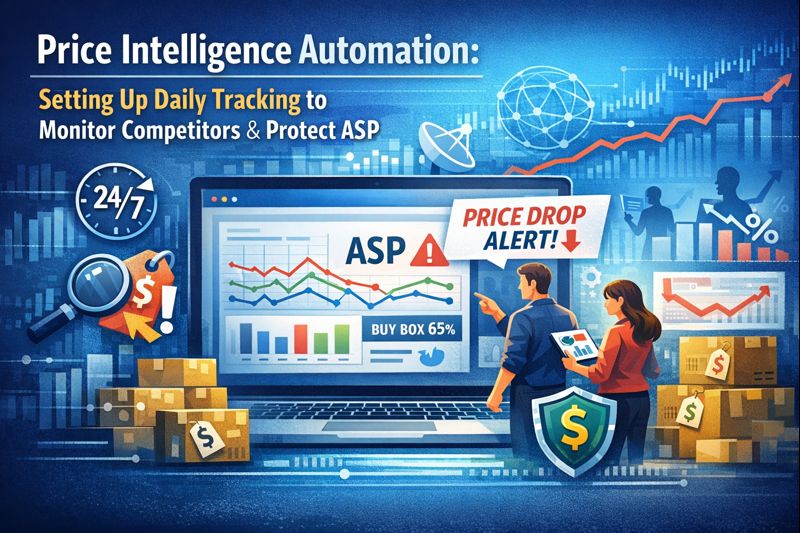
If you’ve ever tried to manage prices manually across multiple marketplaces, you know it’s chaos. One day, you’re competitive. The next, a rival drops their price by 50 cents — and suddenly, your Buy Box disappears.
Price management sounds simple until you’re dealing with dozens of SKUs, different regions, and sellers who seem to change prices while you’re asleep. That’s exactly why Price Tracking and automation have become essential.
At Perfality, we’ve seen brands burn entire afternoons comparing listings by hand. The problem isn’t effort — it’s speed. Pricing is a moving target, and by the time you catch up, the data is already old.
Why manual tracking doesn’t work anymore
Most pricing issues don’t come from strategy; they come from lag. A brand sets the right price on Monday, but by Wednesday, the market has shifted. Competitors run flash discounts, inventory changes, or someone new undercuts you by pennies.
Without Automated Monitoring, you’re reacting too late. You might drop prices too far, or worse, leave them too high while everyone else is adjusting. Either way, your Average Selling Price (ASP) starts to slip — and recovering from that is harder than most teams expect.
Automation fixes that by pulling real-time data from marketplaces and flagging what’s changed — not once a week, but daily (or even hourly). You don’t need to keep refreshing tabs; you just need alerts that tell you when to move.
Setting up daily tracking that actually works
Daily tracking isn’t just about gathering numbers. It’s about tracking the right ones.
The first step is deciding which SKUs deserve close attention — usually your high-volume or high-margin products. Then, automation tools monitor competitor prices, shipping costs, and promotions on those SKUs every day.
Here’s what a good system tracks:
- Current market price for each competing seller.
- Your own Buy Box share.
- Price trends over time (not just today’s snapshot).
- Sudden undercuts that can trigger ASP drops.
When you see those changes clearly, your pricing team can act — not guess.
Protecting your Average Selling Price
A big mistake many brands make is chasing competitors too aggressively. They match every price drop instantly, thinking it’ll win sales. But when you keep undercutting, your Average Selling Price (ASP) erodes — and even when the market stabilizes, your margins don’t recover.
That’s where automation helps again. It lets you respond intelligently instead of emotionally. You can set guardrails: match prices only when drops cross a certain threshold, or pause discounts when competitors are clearly dumping inventory.
Smart pricing isn’t about being cheapest — it’s about staying consistent.
Why data is only half the story
Automation gives you information, but decisions still come from people. The key is interpreting what those price shifts mean.
Sometimes a competitor’s drop signals a clearance. Other times, it’s just a short-term test. By linking Price Tracking data with sales performance, you can see which moves actually affect your conversions — and which are just noise.
That’s where teams find real control: knowing when to move and when to hold.
The Perfality approach
We’ve helped brands build Automated Monitoring systems that collect marketplace prices daily, compare them against target ASPs, and send simple reports — not hundreds of rows of data, just actionable updates.
Once that’s in place, pricing stops feeling like guesswork. You don’t lose time chasing spreadsheets, and your team can focus on strategy instead of reaction.
At Perfality, we look at automation as a guardrail. It doesn’t replace your pricing team — it keeps them informed, calm, and one step ahead. Because in e-commerce, the brands that watch the market daily don’t just compete — they control the pace.