


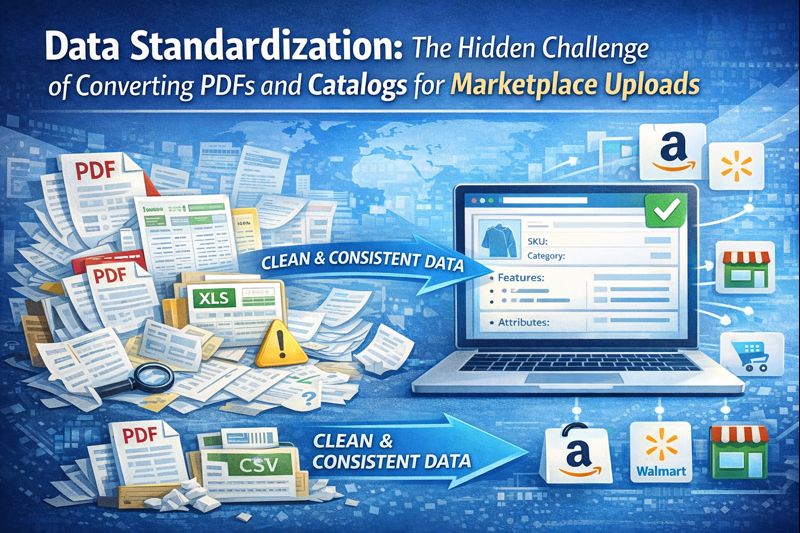
If you’ve ever tried uploading a full product catalog to Amazon, Walmart, or any other marketplace, you already know how messy it gets. Every platform has its own set of rules — one wants bullet points, another wants features as attributes, and a third insists on different naming conventions altogether.
Now, if your product info lives in PDFs, old Excel sheets, or some outdated ERP export, the mess only gets worse. That’s where the real headache begins.
At Perfality, we’ve helped plenty of brands clean up this chaos. Data standardization isn’t the flashiest part of e-commerce, but it’s the difference between a product that goes live smoothly and one that keeps bouncing back with errors.
Why messy data slows everything down
When product data isn’t consistent — different spellings, mixed measurements, missing fields — everything else starts breaking. Uploads fail, templates don’t match, and automation tools can’t do their job.
That’s where Data Cleansing makes a difference. It’s more than cleaning up spelling mistakes; it’s about giving every product the same clear structure. Dimensions are written one way, materials are labeled correctly, and naming is consistent across the board.
We once worked with an apparel brand that had six variations of “navy blue” in their catalog — small details like that kept hundreds of SKUs from uploading. Once we standardized the file, their listings went live within a day.
Why converting PDFs isn’t as simple as exporting
A lot of suppliers and manufacturers still use PDFs as their “catalog.” Those files weren’t built for online marketplaces, and it shows. They have missing labels, merged tables, and inconsistent formats that break when you try to copy data out.
That’s why Data Migration isn’t just about moving info — it’s about reshaping it. You need to define what each column actually means, build rules for how attributes are written, and make sure duplicates are caught early.
It takes time the first go-round, but once it’s done, updates later are faster and cleaner.
Building a catalog that doesn’t break every week
Here’s what most teams eventually learn: if your catalog data isn’t standardized, you’re just patching holes every time you add new products.
For long-term success, you need one reliable version of your catalog — a clean file that every system and marketplace pulls from. It doesn’t have to be fancy. It just has to be right.
That single version cuts down endless edits and keeps everyone (from marketing to operations) on the same page. Once that’s in place, Catalog Management stops feeling like firefighting and starts feeling routine.
Why this kind of cleanup actually pays off
Bad data doesn’t just create errors — it drains time, stalls launches, and makes teams frustrated. Clean, consistent data may not look exciting, but it’s the backbone of every other automation and growth effort you want to build.
At Perfality, we help brands get there step by step — cleaning up what’s broken, mapping old catalogs into new formats, and creating simple systems that stay accurate over time. It’s not about perfection; it’s about control.
Because when your catalog is clean and reliable, your team stops wasting hours fixing uploads and starts focusing on what really matters — selling more.