


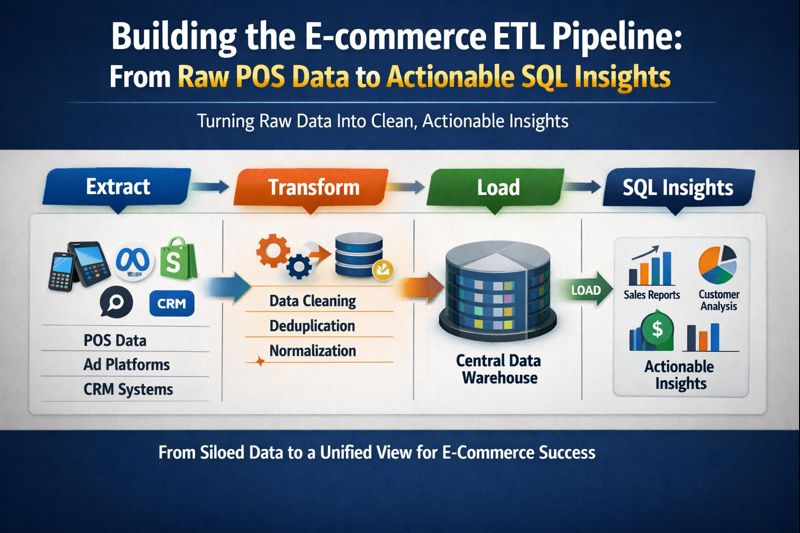
Every e-commerce business sits on more data than it realizes. Sales transactions, refunds, ad performance, customer behavior — it’s all there, scattered across platforms. But raw data by itself doesn’t help much. What really matters is turning that noise into something useful and usable. That’s where a well-built ETL (Extract, Transform, Load) pipeline comes in.
Think of it as the plumbing that moves information from different systems — your POS, marketplace dashboards, CRMs, and ad platforms — into one reliable source of truth. Once that’s in place, your team can actually use SQL for E-commerce to run clean reports, analyze performance, and make confident decisions.
At Perfality, we’ve built these systems for brands that were drowning in spreadsheets. The shift wasn’t just technical — it changed how they understood their own business.
The chaos before structure
Before an ETL (Extract, Transform, Load) process exists, most data lives in silos. A sales manager downloads daily reports from Shopify. The ad team tracks spend on Meta and Amazon. Finance keeps numbers in separate Excel files. Everyone is looking at a different version of the truth.
That kind of setup works—until it doesn’t. As soon as you try to scale or reconcile numbers across platforms, the cracks show. Duplicate records, mismatched dates, and formatting errors pile up. You spend more time verifying data than using it.
That’s usually the moment brands realize they don’t have a reporting problem — they have a Data Engineering problem.
The anatomy of a strong ETL pipeline
A proper ETL (Extract, Transform, Load) setup starts by connecting every source where data lives. “Extract” pulls the raw information from your POS systems, ad platforms, CRMs, and warehouses. “Transform” cleans and reshapes it — aligning column names, currencies, and time zones, and fixing duplicates. “Load” then places the cleaned data into a central warehouse where everything can finally speak the same language.
Once that’s done, your data becomes ready for use. Instead of pulling random CSVs, your team can write a few lines of SQL for E-commerce and instantly see metrics like conversion by channel, refund trends by SKU, or profit by fulfillment type.
The magic isn’t just in the tools — it’s in how consistently they work together.
Making data work harder
The real advantage of a strong data setup isn’t that it looks sophisticated — it’s that it saves time. Once your ETL (Extract, Transform, Load) pipeline is running smoothly, every new data source fits in without creating chaos. You can plug in marketplaces, ad accounts, or even warehouse feeds and trust that everything lands in one clean, reliable view.
We saw this firsthand with a consumer brand that was juggling half a dozen spreadsheets from different systems. After setting up a simple, automated ETL pipeline, they replaced ten manual reports with a single dashboard that updated itself every hour. Meetings stopped being about “whose numbers are right” and turned into discussions about what to do next. That’s the kind of clarity good Data Engineering creates — less noise, more action.
Final takeaway
Data doesn’t drive growth on its own. What makes the difference is the structure behind it — and how easily your team can get to the answers that matter. A solid ETL (Extract, Transform, Load) foundation and a few well-written SQL for E-commerce queries can turn messy reports into insights that actually change how you operate day to day.
At Perfality, we help teams build that kind of structure. We take the pain out of scattered data and design systems that quietly handle the heavy lifting in the background. The goal isn’t to collect more information — it’s to make smarter decisions, faster, and with confidence that your numbers are right.