


- Perfality
- April 10, 2026
- 3:14 pm
- Read Time: 5 mintues
Let’s be honest – this question comes up in almost every initial call we have with a new client.
“Should we be on Google or Facebook?”
And honestly, there is no clean, one size fits all answer. What we have learned from working across different industries ecommerce brands, local service businesses, D2C startups, is that the right platform depends less on what is trending and more on how your customers actually think and behave.
So let us break it down the way we actually think about it.
The Core Difference – And Why It Changes Everything
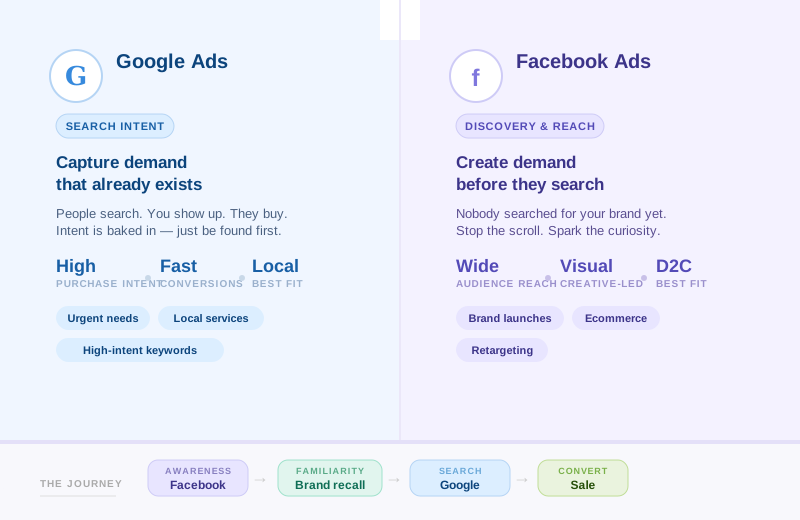
Google Ads is built around intent. Someone types “best running shoes under 3000” or “AC repair near me” they already know what they want. They are ready to act. Your ad simply needs to be seen at the right time in the correct context.
Facebook Ads works completely differently. When was the last time anyone opened Instagram and thought, I am sure there’s a really cool new skincare brand that I should definitely try. But then they see your ad between two reels and suddenly they are clicking.
That is the real distinction: Google captures existing demand. Facebook creates new demand. Once you understand that, the decision becomes a lot clearer.
When Google Ads Is the Right Call
Google tends to work really well in a few specific situations:
Your product or service is something people already search for. If someone is Googling it, they are halfway to buying. You just need to be the result they trust.
You are a local business. “Plumber in Noida” or “wedding photographer in Delhi” these searches have high purchase intent baked in. People are not casually browsing.
The need is urgent. When someone needs something quickly repairs, medical services, deliveries – they go to Google first. And they tend to choose from the first two or three results.
When Facebook Ads Makes More Sense
Facebook and Instagram shine in situations where discovery is the goal:
You are selling something visual. Fashion, home decor, food, and fitness products, these categories thrive when people can see and feel the product before clicking. A strong creative does that job.
You are launching something new. If your product does not exist in people’s minds yet, nobody is searching for it on Google. You have to go to where people already are and introduce it to them.
You want to build brand recall. Even if someone does not buy immediately, a well-targeted Facebook campaign plants a seed. The next time they need what you offer, your brand comes to mind.
Here Is What Actually Works Best
Most businesses we work with do not use just one platform and there is a reason for that.
The approach that tends to perform best looks something like this: use Facebook Ads to reach people who have never heard of you. Get them curious. Build some familiarity. Then when they go to Google a few days later, because they are now ready to look it up – your brand already feels familiar. That trust shortcut is incredibly valuable.
It is not complicated. But it does require thinking about both platforms as parts of the same journey, not separate experiments.
Common Mistakes We See Brands Make
Some patterns repeat over and over: Jumping on a bandwagon for no strategic reason. Just because a competitor is achieving success on Facebook does not mean it’s the right channel for your product.
Running Facebook Ads with weak creatives. On Facebook, your visuals are your ads. Nothing else matters if it doesn’t stop the scroll.
Running Google Ads without understanding search intent. Targeting broad, irrelevant keywords burns budget fast with very little to show for it.
Completely skipping retargeting. This one surprises people. Most customers do not convert on the first visit. Retargeting is what brings them back and it is often where the real returns come from.
How We Think About This at Perfality
At Perfality, we do not start with the platform. We start with the business.
Before we recommend anything, we want to understand what is the product, who is the buyer and at what stage of awareness are they? That tells us a lot more than any general best practice could.
For Facebook, we invest heavily in the creative side because that is honestly where most campaigns are won or lost. For Google, the focus is on getting the keyword targeting right and making sure the landing experience holds up.
And because we work closely with ecommerce brands, we also look at things beyond the ad – product pages, pricing, checkout flow. An ad can drive traffic, but if the rest of the experience is off, conversions will suffer regardless of the platform.
We also never set campaigns and forget them. Continuous testing and iteration is just how good media buying works.
So, which should you pick?
Start with Google if you need conversions right away and your audience is actively looking for what you have to offer.
Facebook is a better place to start if you’re seeking to reach individuals who don’t already know you or if you’re gradually developing your brand. But if you are thinking about real growth – the kind that compounds over time – both platforms have a role to play. The question is not which one to pick. It is getting them to work with each other.
We are also happy to walk through what makes sense for your individual business. No pitch, just an honest conversation.