




- Perfality
- October 21, 2026
- 2:23 pm
- Read Time: 10 mintues
Some of the most expensive mistakes in a Home Depot catalog never appear on a product page. Nobody shopping on the site will ever see the packaged dimensions of a drill kit or the hazmat classification of a spray can. Yet these two data points decide how an item is shipped, stacked, routed and whether it can be sold at all.
Both are easy to get wrong and slow to correct. This article explains why Home Depot packaged dimensions matter more than they seem, how hazmat registration works through WERCSmart, and how to audit both before they cost you a penalty.
Why Home Depot Packaged Dimensions Matter More Than They Look
Home Depot’s IDM onboarding guide explains that the containerization tool uses the packaged dimensions and weight from IDM to calculate the cubic volume of each order. If the inputs are wrong, the volume is wrong, and so is everything that depends on it, including how many items fit on a truck.
The guide gives examples of the errors it sees: an extra pallet level entered for an item that is not palletized, depth and height entered the wrong way round, and target dimensions entered instead of actual ones. It also notes that suppliers cannot edit packaged dimensions on existing items. Corrections go through a ticket or an email to Home Depot’s IDM support team.
A Worked Example: Packed Versus Assembled
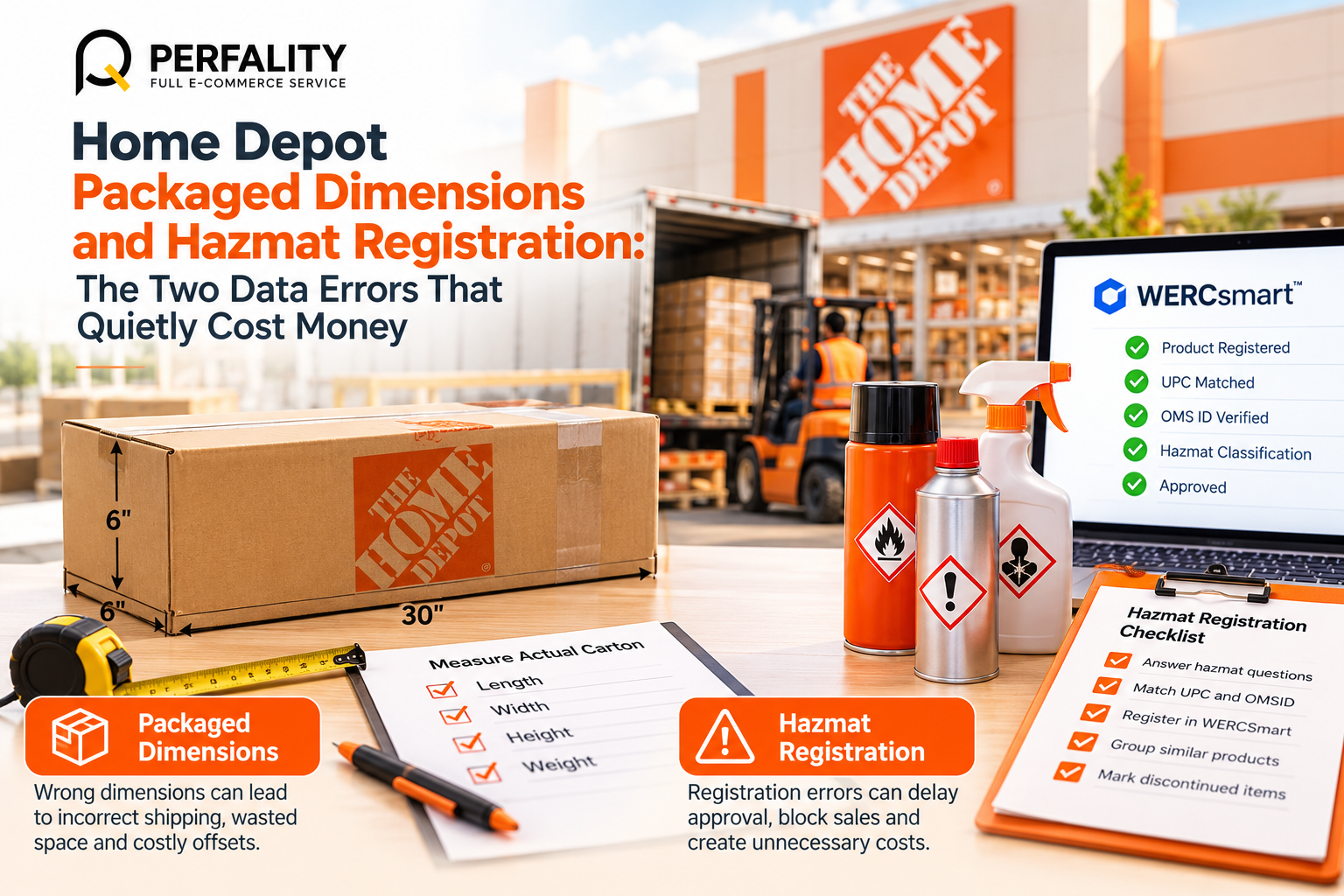
Suppose a 30-inch tool is shipped in a carton that measures 30 x 6 x 6 inches. That is 1,080 cubic inches. If the supplier enters the assembled footprint of 30 x 30 x 6 inches instead, the system sees 5,400 cubic inches. The product has not changed, but the calculated volume is five times larger.
The result is wasted trailer space and orders that look larger than they are. Compliance guides also list a $1,000 per item offset for supply chain data errors, so a wrong figure can cost real money.
Packaging level | What to record | Typical error |
Each (EA) | UPC, packed dimensions and weight. | Assembled instead of packed dimensions. |
Inner pack (PK) | Unique GTIN and barcode. | Reusing the each-level GTIN. |
Case (CA) | Unique GTIN, case dimensions, pack quantity. | Estimated, not measured. |
Pallet (PL) | Stackable flag and case layers. | A pallet level entered for non-palletized items. |
Hazmat Registration Through WERCSmart
Within IDM, each item has a set of hazmat questions on the WERCS certification tab. If any answer is yes, or the category is typically hazmat, the item must be registered in WERCSmart using the UPC and OMSID exactly as they appear in IDM. The guide says the item should clear the hazmat workflow within three business days.
- Answer the questions every time. An unanswered hazmat question is a common reason an item stalls at review.
- Match identifiers exactly. A mismatch between the UPC in IDM and the one in WERCSmart creates a registration that cannot be linked.
- Group similar products. The guide says a single registration can combine up to 500 UPCs of similar products, which can reduce subscription costs.
- Retire discontinued items. Marking obsolete items avoids paying for registrations you no longer use.
Example: A 120-SKU Aerosol Line
A supplier launches a line of 120 aerosol products. Registering each one separately would be slow and expensive. Grouping similar formulations into shared registrations, within the 500-UPC limit, cuts both the workload and the cost, while keeping every UPC correctly linked.
A Pre-Submission Data Audit
- One real shipping carton measured and weighed per item
- Packed dimensions entered, not assembled or target dimensions
- A unique GTIN at every packaging level
- Pallet level entered only where the item is actually palletized
- Nested increment entered for nestable items
- All hazmat questions answered on the WERCS tab
- WERCSmart registration matches the UPC and OMSID in IDM
- Discontinued items marked obsolete
How Wrong Cube Data Shows Up in Operations
Packaging errors rarely announce themselves. They show up as trailers that look full but are not, as freight costs that do not match the plan, and as penalties that seem to have no clear cause. The data error is upstream, and the symptom is downstream, which is why it takes so long to connect the two.
- Overstated cube: Orders appear larger than they are, trucks leave with unused space and per-unit freight cost rises.
- Understated cube: Loads are planned too tight, cartons do not fit and shipments are delayed.
- Wrong pallet data: Stacking assumptions fail and cartons arrive damaged or rejected.
Who Should Own Packaging Data?
In many companies, packaging data is entered by the person loading items and checked by no one. A better pattern is to give ownership to someone who can see both sides: the warehouse that measures and the team that submits.
- Warehouse measures. A named person measures one real carton per new item and records it.
- Data team enters. A second person enters the figures into IDM and attaches the photo.
- Quarterly spot check. Ten items are re-measured each quarter to catch drift when packaging changes.
A routine like this takes a few hours a quarter and prevents the kind of correction that otherwise takes weeks.
Daily monitoring catches many of these problems early. Our guide to a daily SKU health check applies directly, and our piece on data standardization explains how to get source data clean before it reaches the retailer.
How Perfality Protects Your Supply Chain Data
We treat packaging and compliance data as a quality-control process, not a data-entry task:
- Carton verification: dimensions and weights checked against real packaging before entry.
- Packaging hierarchy review: every level checked for unique GTINs, barcodes and correct pallet data.
- Hazmat readiness: questions answered, identifiers matched and registrations grouped sensibly.
- Data monitoring: recurring checks supported by the tools in our technology stack.
- Correction support: ticket preparation with photos and measurements for existing items.
Related Services
If packaging or hazmat data errors keep appearing, an upfront data audit usually costs far less than the corrections. For the full picture of what we do for suppliers selling to The Home Depot, see our Home Depot account management service. Depending on where this issue keeps recurring, this is the kind of support that typically helps:
- Full-service Amazon management: Full Service Amazon Management, Full Service Amazon Agency, Amazon Full Service Agency, Full Service Amazon Marketing Agency, Best Full-Service Amazon Agency, Best Full Service Amazon Agency
- FBA-focused support: Amazon FBA Management Agency, Amazon FBA Agency, Amazon FBA Marketing Agency, Amazon FBA Management Service
- Listing and content optimization: Amazon Listing Optimization Services, Amazon Listing Optimization Agency, Amazon Listing Optimization Service, Amazon Product Listing Optimization Service, Amazon Product Listing Optimisation Service, Amazon Product Listing Optimisation Service USA
- Product listing services: Amazon Product Listing Service, Amazon Product Listing Service Provider, Best Amazon Product Listing Service Agency
- PPC and advertising management: Amazon PPC Management Service, Amazon PPC Management Service Agency, Best Amazon PPC Management Service, PPC Management Service For Amazon
- Account management: Best Amazon Account Management Services, Amazon Ecommerce Company
If this is a recurring pain point rather than a one-off, it’s usually worth a quick conversation. Book a free 30-minute call with our team and we’ll walk through what’s actually happening on your account.
Frequently Asked Questions
Home Depot’s containerization tool uses them to calculate the volume of each order, so errors can distort shipping plans and increase costs.
Suppliers cannot edit them on existing items. You need to submit a ticket or email Home Depot’s IDM support team.
Home Depot’s guide says an item should clear the hazmat workflow within three business days after it is registered in WERCSmart.
The guide says similar products can be combined into one registration of up to 500 UPCs, which can reduce subscription costs.
Have any questions? Let’s connect!