




- Perfality
- July 10, 2026
- 3:44 pm
- Read Time: 8 mintues
Returns are the cost nobody budgets for properly. You plan for ad spend, storage fees, and referral fees — then a chunk of your margin quietly disappears into a return that a clearer photo or better bullet point could have prevented.
If you run an Amazon store, work with an Amazon FBA management agency, or manage a catalog as a growing Amazon ecommerce company, returns are not a side issue. They’re one of the biggest silent drains on profitability, and most sellers only check the number once a quarter — by which point the damage is already baked in.
This post covers where returns actually come from, which part of your listing is usually to blame, and what you can change this month without a full operational overhaul.
Why Returns Happen in the First Place
More often than not, the fundamental reason lies in expectations not being met: the customer expects to receive something, and gets something technically correct but different from what they pictured.
A few patterns repeat constantly:
- Sizing and fit. A customer skims a title, skips the size chart, and orders the wrong thing.
- Promotional copy. Words like “premium” or “best-in-class,” without any backing detail, just lead the buyer to assume — usually incorrectly.
- Photos that flatter rather than inform. Great lighting sells the click but doesn’t always show scale, material, or real-world context.
- Buyer’s remorse on impulse categories. A pricing and psychology problem, not a content one — listing fixes won’t touch it.
- Damage in transit. People jump to this first, but it’s usually a smaller slice of total returns than assumed.
The useful split: which of these can your listing actually fix? Damage is a packaging conversation; remorse is mostly out of your hands. But sizing confusion, vague copy, and misleading photos are all listing content — and content is something you control completely.
Fixing the Listing Itself
This is where most of the real work happens, and it’s less glamorous than people expect. It’s also the exact ground a solid Amazon listing optimization service works on — daily, ongoing discipline, not a one-time pass.
- Rewrite bullets around decisions, not features. “Fits mattresses up to 12 inches” prevents more returns than “extra thick design.”
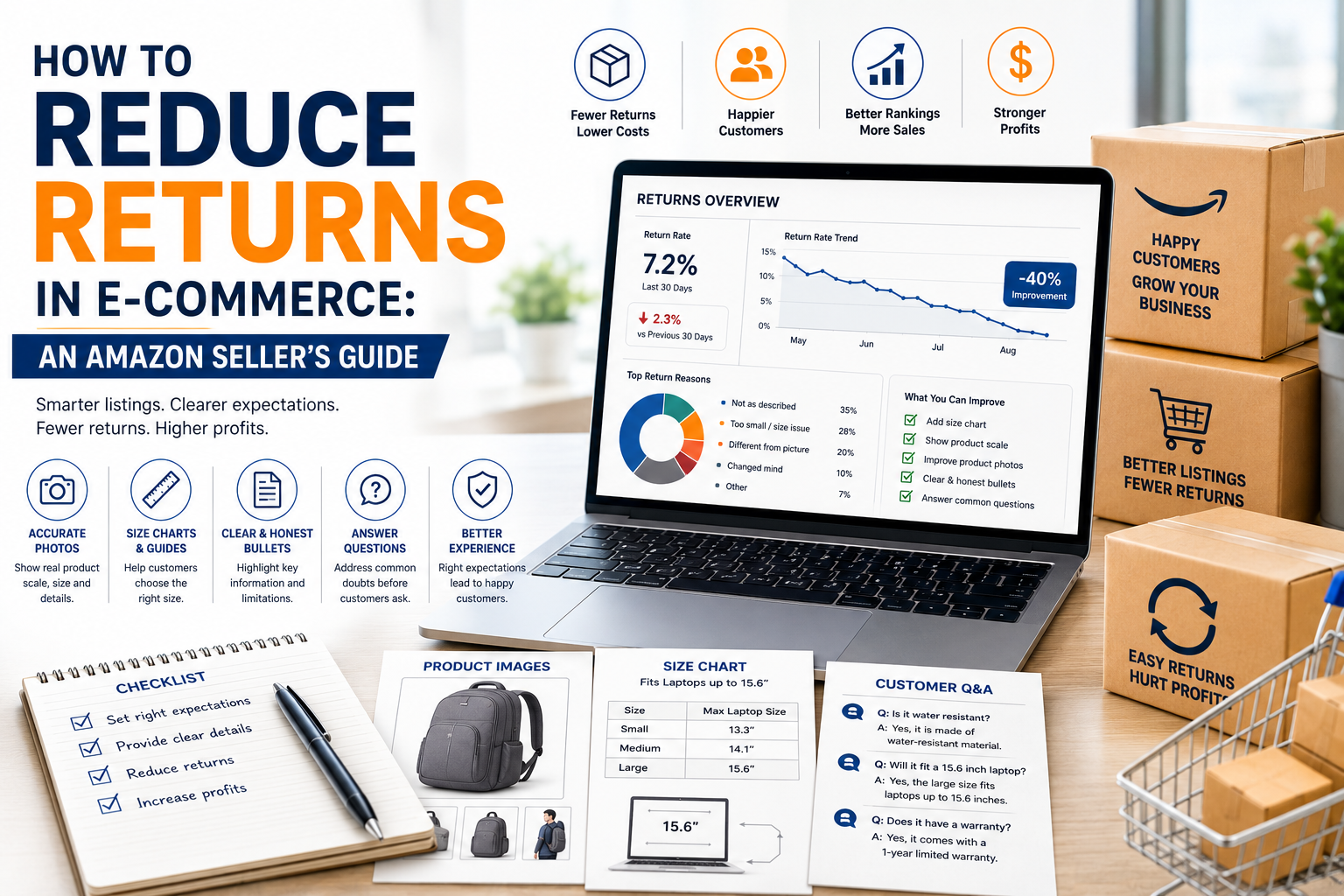
- Use size charts and comparison visuals, not just labels. Embed a size chart image in position two or three of your listing photos — not buried in a PDF or the description.
- Show scale honestly. A product next to a hand or a coffee cup tells a customer more in half a second than three lines of dimensions.
- Add a lifestyle image that shows limitations, not just strengths. A picture of what the product does not do eliminates buyers who never would have been happy.
- Respond to questions based on what people are really searching for. If a Q&A or review question comes up more than twice, that’s a gap in your listing — bring it up as a bullet.
- Watch return reason codes, not just the return rate. “Not as described,” “too small,” “different from picture” — these are the actual diagnosis. A rise in “not as described” is a content issue, not product, and packaging won’t fix it.
This is what differentiates a real Amazon listing optimization agency from an individual rewriting bullets for you: the diagnosis-first thought process. Whether you’re comparing an Amazon product listing service provider or shortlisting the best Amazon product listing service agency, ask how they use return data — not just how they write copy.
Where AI Discovery Adds a New Layer
Rufus and similar AI shopping assistants shift this calculation. Rufus reads your full listing and synthesizes an answer rather than matching keywords. Vague or overstated content means Rufus can recommend your product to the wrong buyer — one arriving already primed for disappointment.
Related reading: Amazon’s own content rules are tightening on the title side too — see our breakdown of the 75-character title cap taking effect July 27, 2026 and what to move into Item Highlights before then.
The fix takes discipline: write listing content that’s specific and honest, not optimized purely for keyword coverage. A listing that states clearly who a product suits — and who it doesn’t — earns fewer wrong-fit recommendations and fewer returns.
This matters more if you’re running ads. A well-run Amazon PPC management service can drive steady clicks, but if the content behind those clicks is vague, that traffic converts into returns instead of repeat customers. Return rate should sit alongside ACOS as a shared metric — it’s a fair question to ask whichever Amazon PPC management agency you’re evaluating.
The Operational Side
Content fixes listing-caused returns. A few things worth doing beyond that — usually where an Amazon FBA agency earns its fee, since it spans sourcing, packaging, and content together:
- Audit packaging for your top return-driving SKUs, not the whole catalog. Fixing a 2%-return product wastes effort compared to one sitting at 15%.
- Read the actual review text on returned items, not just the star rating — customers are often more honest there than in the return reason dropdown.
Loop findings back to sourcing. A genuine quality issue is a supplier conversation, not a copywriting one.
How Perfality Can Help
Most sellers know their return rate is a problem long before they know why. That’s usually where we come in.
At Perfality, our catalog management work means going listing by listing — matching return reason codes against the actual bullets, photos, and titles to find the specific gap causing the mismatch. Sometimes it’s a size chart buried three images deep; sometimes it’s a bullet that oversells a feature. We’ve seen both often enough to spot them fast.
We also handle what most sellers don’t have time for: rewriting bullets around real buyer decisions, restructuring image sequences, and setting up a review process so return data actually feeds back into listing updates. This is what our full-service Amazon management is built around — content, PPC, and account health working off the same data.
If your return rate has been creeping up and you’re unsure which SKUs are driving it, that’s a good place to start a conversation with us.
Final Thought
Reducing returns rarely comes down to one big fix. It’s a handful of small corrections — a size chart added, a bullet rewritten honestly, a lifestyle photo that shows real limitations — that compound over a few months. None of it is dramatic, but it shows up directly in your bottom line, often faster than a new ad campaign would.
Whether you handle this in-house, work with a full-service Amazon agency, or bring in a dedicated Amazon product listing optimization service, the work doesn’t change: someone has to go listing by listing and close the gap between what’s promised and what ships. The best full-service Amazon agency for your catalog is the one that treats returns as a metric worth reporting on, not an afterthought.