




- Perfality
- October 27, 2026
- 11:27 am
- Read Time: 10 mintues
Shipping is where a Target Plus store is won or lost. A customer who orders from Target expects the order to arrive when promised, in good condition, with tracking they can trust. Target Plus shipping is the part of the experience that sellers control completely, which means every late box reflects on you.
This guide sets out eight rules for Target Plus fulfillment, a fictional order-cycle example with a time budget and a monthly review routine. Target’s detailed shipping standards are shared with approved sellers, so the specifics below come from third-party guides and general marketplace practice. Confirm every deadline and carrier rule with Target before you launch.
What Target Plus Shipping Asks of Sellers
Seller guides describe Target Plus shipping as a U.S. program where sellers ship their own orders from U.S. locations, using carriers such as UPS, FedEx or USPS. Several guides also say that orders from Target cannot be fulfilled through Amazon FBA or Walmart fulfillment, so the stock you hold for those programs cannot simply be reused.
That makes Target Plus fulfillment a real operational commitment, and Target Plus shipping is where that commitment shows. You need inventory in the right place, a pick-and-pack routine that runs every working day and a way to send tracking back quickly. Brands that treat Target as an extra feed on top of existing channels often discover this too late.
The rules below are practical. They do not replace Target’s own seller manual, but they describe the habits that keep a new store out of trouble.
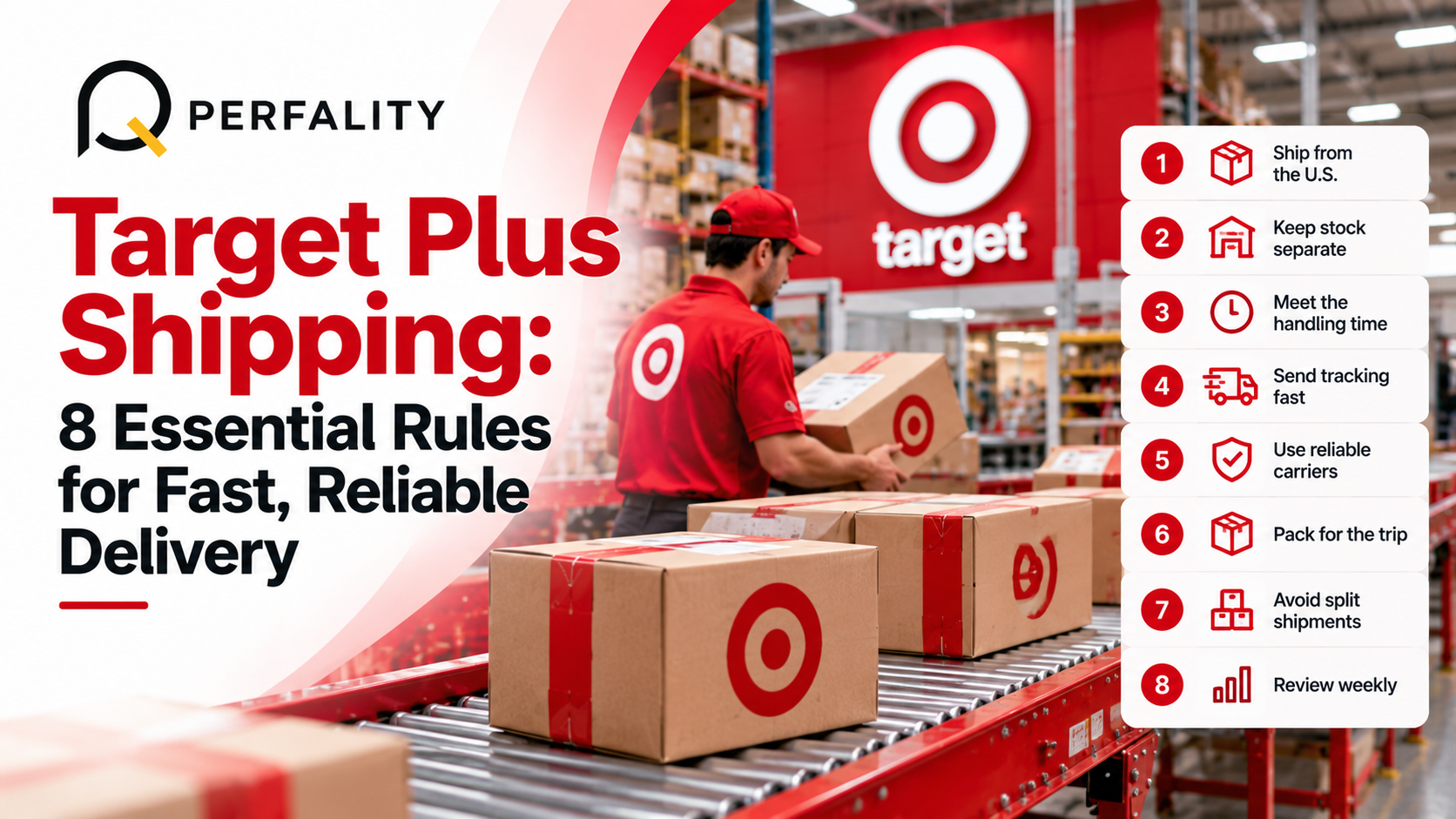
8 Essential Rules for Target Plus Shipping
Rule | What it means | Common slip |
1. Ship from the U.S. | Use a U.S. warehouse or 3PL for Target orders | Planning to ship from overseas |
2. Keep stock separate | Hold inventory for Target if other programs cannot supply it | Counting FBA stock as available |
3. Meet the handling time | Ship within the time you promise | Promising 1 day and shipping in 3 |
4. Send tracking fast | Upload valid tracking as soon as a label is scanned | Uploading it days later |
5. Use reliable carriers | Pick carriers with strong coverage for your zones | Choosing the cheapest, slowest option |
6. Pack for the trip | Protect the product and avoid damage claims | Oversized boxes with no padding |
7. Avoid split shipments | Send one order in one package where possible | Doubling label costs by accident |
8. Review weekly | Check late, cancelled and damaged orders | Looking only after a complaint |
Each rule protects a part of your seller record. Guides describe performance expectations such as shipping on time and keeping cancellations low, and those numbers shape how Target views your account.
Rules 1 and 2: Place your inventory correctly
Start with a stock plan for Target Plus fulfillment. Decide which warehouse serves Target Plus and how much inventory to hold there. If you use a third-party logistics provider, confirm in writing that it can pick, pack and label to the standards you need. Our article on e-commerce operations outsourcing explains how to evaluate a partner like this.
Rules 3 and 4: Promise what you can deliver
For Target Plus shipping, set a handling time you can meet on your worst day, not your best. A promise of two days that you hit every time beats a promise of one day that you miss twice a week. Send tracking as soon as the label is scanned, because customers check tracking before they check anything else.
Rules 5 and 6: Choose carriers and packaging with care
Compare carriers by zone, weight band and delivery speed, not only by price. Test packaging with a few sample shipments. A box that survives your own warehouse can still fail on a long route. Damage and breakage are costly, because replacement and return shipping come out of your margin.
Rules 7 and 8: Reduce waste and review often
Split shipments double your label cost and confuse customers. Group items so an order leaves in one box when stock allows. Then review late, cancelled and damaged orders every week and find the cause behind each one.
A Fictional Order Cycle for Target Plus Fulfillment
Let us follow one order for an invented brand, Cedar & Coil, that sells small kitchen appliances from a single U.S. warehouse. The brand promises a two-day handling time. The table shows how it spends that time.
Step | Owner | Time budget |
Order arrives in the order system | Integration | Minutes |
Order is reviewed and released to the warehouse | Operations | Same day |
Item is picked, packed and labeled | Warehouse | Within one day |
Carrier scans the package | Carrier | Same or next day |
Tracking uploaded to Target | Integration | Minutes after scan |
Spare day held as a buffer | All | One day |
The brand deliberately uses only one of its two promised days in normal conditions. The spare day absorbs staff absences, carrier pickups that run late and weekend gaps. This is the same logic as keeping safety stock: build slack where you know delays happen.
The example is fictional, but the principle is general. Promise a number, measure your real average and keep a margin between them. A store that always ships a day early is a store that rarely misses.
What Target Plus Shipping Really Costs
Shipping is often the largest single cost after the product itself. Costs depend on weight, size, zone and speed, so your numbers will differ from any example. Break Target Plus shipping into pieces so you can see where savings are possible.
- Label cost: the carrier charge for the package, often based on weight and zone.
- Packaging: boxes, padding and tape, which add up on fragile items.
- Handling: pick, pack and storage charges if you use a warehouse partner.
- Returns: the cost of return labels and restocking, if you cover them.
- Claims and losses: damaged or lost packages that you replace.
Add these to your margin model before you set a price. Treat the total as a fixed part of your Target Plus shipping budget, and compare it with the shipping cost on your other channels before you finalize a price.
Choosing a Partner for Target Plus Fulfillment
Many brands use a third-party logistics provider, or 3PL, for Target Plus fulfillment because it removes the need to build a warehouse. A good partner is a major advantage. A poor one becomes the cause of every late order. Ask these questions before you sign.
Question | Why it matters | Good answer |
Can you integrate with my order system? | Manual order entry is slow and error-prone | Yes, with a tested connector |
What is your cutoff time for same-day shipping? | Sets your real handling time | A clear time, with a written service level |
How do you handle damaged or short inventory? | Protects your stock records | Counts, reports and a documented process |
What do you charge for returns and storage? | Affects margin | A published rate card with no surprises |
Who is my contact when something goes wrong? | Speeds up problem solving | A named person and a response time |
Run a short pilot before sending your full range. Ship twenty real orders and measure speed, accuracy and damage. If the pilot shows problems, fix them while the volume is small. Strong Target Plus fulfillment is built from tested habits, not from hope.
Keeping Customers Informed After They Order
Even good Target Plus shipping produces questions. Customers want to know when the order will leave, whether it is delayed and how to return it. Clear, early messages prevent most complaints and protect your seller scores.
- Confirm the order and give an honest delivery window.
- Send tracking as soon as it exists, with a plain link.
- Warn customers early if a delay is likely, and offer options.
- Answer messages quickly, including during weekends in busy periods.
Our customer service project describes how we help sellers keep response times short across channels. Fast answers turn a potential bad review into a satisfied customer.
Peak Season and Target Plus Shipping
Holiday weeks stress every part of Target Plus shipping. Carriers add surcharges and slow down, warehouses run short of staff and customers order closer to deadlines. Plan well before the peak, not during it.
- Forecast demand. Use last season’s sales from other channels and adjust for growth.
- Stock early. Move inventory to your warehouse before carriers get busy.
- Book capacity. Tell your warehouse partner your expected volume in advance.
- Check cutoff dates. Confirm the last day to ship for each service level.
- Keep a manual plan. Decide who pauses listings if stock or capacity runs out.
Brands that rehearse peak weeks in October rarely panic in December. If Target Plus fulfillment is new to you, a small test run with real orders will show gaps that spreadsheets hide.
Packaging and Labeling Basics
Packaging is the last thing your team touches and the first thing a customer sees. A clean, right-sized box looks professional and protects the product. A crushed box with a hand-written label does the opposite, and it can lead to a damage claim before the customer has even opened it.
- Right-size the box so the product does not move, but avoid heavy extra fill.
- Print labels clearly, with the correct address and any order reference required.
- Include a simple packing slip with return instructions.
- Use inner protection for glass, electronics and other fragile items.
- Test two or three package designs with real shipments before settling on one.
Keep a log of damage by product and by carrier. If the same item arrives broken twice, change the packaging before shipping a third box. Small improvements here compound, because every avoided replacement saves the product cost, the label cost and the return cost together.
A Monthly Review Routine for Target Plus Shipping
Good Target Plus shipping is a habit. A monthly review keeps small problems from growing. Pull the numbers that matter and ask one question about each: why did this happen, and what will we change?
Measure | Question to ask | Typical action |
Late shipments | Which days or products slipped? | Adjust staffing or handling time |
Cancellations | Was stock wrong or demand sudden? | Fix inventory sync and safety stock |
Damage claims | Which items and routes failed? | Change packaging or carrier |
Tracking delays | How long from scan to upload? | Fix the integration step |
Cost per order | What changed since last month? | Renegotiate or reroute |
Our SKU health check approach pairs well with this routine, because stock errors and shipping failures are often two sides of the same problem.
- U.S. warehouse or 3PL confirmed for Target orders
- Inventory set aside for Target if other programs cannot supply it
- Handling time chosen with a spare-day buffer
- Tracking upload tested end to end
- Carriers compared by zone, weight and speed
- Packaging tested with sample shipments
- Split-shipment rules written down
- Weekly and monthly reviews scheduled
How Perfality Supports Target Plus Shipping
Strong fulfillment starts with clean data and clear routines. For Target Plus shipping we typically help with:
- Reviewing your fulfillment plan, handling time and inventory placement before launch.
- Checking that stock levels and tracking updates flow correctly into Target.
- Daily monitoring of late, cancelled and at-risk orders.
- Customer service coverage so Target Plus shipping questions are answered quickly.
- Ongoing store handling through our Target Plus marketplace management
On-time delivery is rarely glamorous, but it is the foundation of every marketplace that lasts.
Related Services
If you want a second pair of eyes on your Target Plus fulfillment plan before launch, our team can help. For the full picture of what we do for sellers and suppliers working with Target, see our Target Plus marketplace management service. Depending on where this issue keeps recurring, this is the kind of support that typically helps:
- Full-service Amazon management: Full Service Amazon Management, Full Service Amazon Agency, Amazon Full Service Agency, Full Service Amazon Marketing Agency, Best Full-Service Amazon Agency, Best Full Service Amazon Agency
- FBA-focused support: Amazon FBA Management Agency, Amazon FBA Agency, Amazon FBA Marketing Agency, Amazon FBA Management Service
- Listing and content optimization: Amazon Listing Optimization Services, Amazon Listing Optimization Agency, Amazon Listing Optimization Service, Amazon Product Listing Optimization Service, Amazon Product Listing Optimisation Service, Amazon Product Listing Optimisation Service USA
- Product listing services: Amazon Product Listing Service, Amazon Product Listing Service Provider, Best Amazon Product Listing Service Agency
- PPC and advertising management: Amazon PPC Management Service, Amazon PPC Management Service Agency, Best Amazon PPC Management Service, PPC Management Service For Amazon
- Account management: Best Amazon Account Management Services, Amazon Ecommerce Company
If this is a recurring pain point rather than a one-off, it’s usually worth a quick conversation. Book a free 30-minute call with our team and we’ll walk through what’s actually happening on your account.
Frequently Asked Questions
Several third-party guides say Target orders cannot be fulfilled through Amazon FBA or Walmart fulfillment. Confirm the current rule with Target before you plan your inventory.
Guides mention UPS, FedEx and USPS. Check Target’s seller manual for approved carriers and labeling rules before you choose.
Exact handling-time targets are shared with approved sellers. Promise a time you can meet even on your worst day, and keep a spare day as a buffer.
Have any questions? Let’s connect!