




- Perfality
- October 27, 2026
- 11:51 am
- Read Time: 10 mintues
Every return has three costs: the refund, the shipping and the product you may not be able to resell. Target Plus returns add a fourth cost for new sellers, which is the damage a poor return experience does to customer trust. A store can grow fast and still lose money if returns are not managed.
This guide offers seven ways to reduce returns, a framework for handling the ones you cannot prevent and a simple response plan for Target Plus customer service. It also includes a fictional example showing how small changes lowered one brand’s return rate. Target’s return rules are shared with approved sellers, so the specifics here come from third-party guides and general marketplace practice. Confirm every rule with Target before you set your policy.
Why Target Plus Returns Deserve Attention Early
New sellers tend to focus on listings and orders, and they put Target Plus returns off until later. Returns feel like a later problem. In practice, returns decide margin. A product with a 25% margin and a 10% return rate keeps far less than it looks like on paper, because each returned unit loses the sale and adds cost.
Customers also judge a brand by how a return feels, and Target Plus returns are no exception. A fast, clear refund creates loyalty. A slow, confusing one creates a bad review. Because Target shoppers expect a polished experience, the standard for Target Plus returns is higher than on many open marketplaces.
Guides disagree on exactly how Target Plus returns flow between Target, the customer and the seller, and who pays return shipping in each case. Ask Target to explain the current process in writing, and build your policy around it.
Why Customers Return Products
You cannot reduce returns until you know why they happen. Most reasons fall into a few groups, and each group has its own fix. The table below shows a common breakdown for general merchandise.
Reason | What it usually means | Best fix |
Not as described | The page promised something the product did not deliver | Correct claims, photos and sizes |
Wrong size or fit | Sizing information was unclear | Add size charts and measurements |
Damaged on arrival | Packaging or carrier failure | Improve packaging and review carriers |
Defective | Quality or handling problem | Fix at the source and inspect stock |
Changed mind | Impulse purchase or price change | Hard to prevent, so plan for it |
Wrong item sent | Warehouse picking error | Add scan checks at packing |
Notice that at least four of the six reasons are within your control. Content, packaging and warehouse accuracy are all things a seller can improve. That is good news, because it means a lower return rate is a realistic goal.
7 Proven Ways to Reduce Target Plus Returns
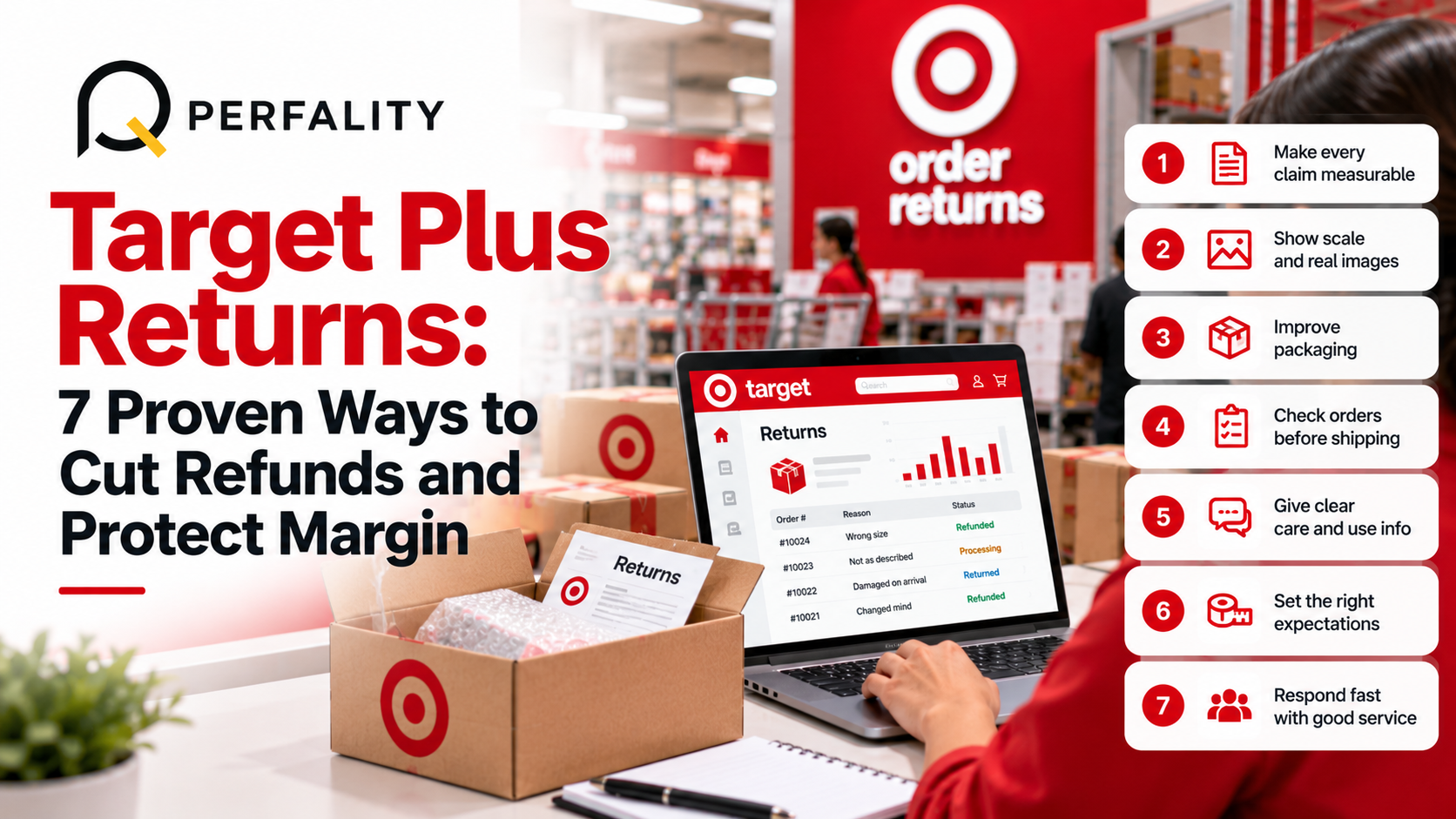
- Make every claim measurable. Replace “large” with the actual dimensions and “durable” with the material.
- Show scale in images. Place the product next to a familiar object, or in a hand.
- Add size and fit guidance. A simple chart removes most sizing returns.
- Test your packaging. Ship samples and inspect them on arrival.
- Add a pick-and-pack check. Scan the barcode before sealing the box.
- Read return reasons weekly. Group them and fix the biggest cause first.
- Fix products with chronic returns. Redesign, re-source or drop items that never improve.
These steps to cut Target Plus returns overlap with listing and fulfillment work, which is the point. Returns are a symptom. The cause usually sits in content, packaging or operations. Our guide on reducing Amazon returns explains the same pattern, and most of its lessons apply directly to Target Plus returns.
A Fictional Example of Lowering Target Plus Returns
Consider an invented brand, Birchwood Kids, that sells wooden toys. In its first two months on Target Plus, it sees a return rate it considers too high. The team sorts the reasons and finds three themes.
Theme | Share of returns | Change made |
Not as described | 40% | Added exact dimensions and an in-hand photo to each page |
Damaged on arrival | 30% | Switched to corner protectors and a stronger box |
Wrong item sent | 15% | Added a barcode scan at packing |
Changed mind | 15% | No change, accepted as normal |
After three months, the team reports fewer complaints in all three targeted groups. We have not invented a percentage here, because the point is the method: sort, find the biggest cause, change one thing and measure again. Brands that follow this loop on Target Plus returns usually see steady improvement, even if each step is small.
The “changed mind” group stayed the same, and that is fine. Some returns are a normal cost of selling online. The goal is not zero returns. It is to remove the avoidable ones.
Building a Return Process for Target Plus Returns
Even with fewer Target Plus returns, you still need a process. Write it down before the first order, so that anyone on the team can follow it. A good process answers five questions.
- Who approves a return, and how quickly?
- Who pays for return shipping in each situation?
- How is a returned item inspected and graded?
- When does the refund or replacement happen?
- Where do damaged or unsellable items go?
Create three grades for returned goods: resell as new, resell at a discount, or write off. Give each grade a clear test, such as sealed packaging for new. A short grading rule saves hours and keeps stock records accurate.
Some returns involve damaged goods or carrier errors that you can claim back. Our guide on warranty claims and damage recovery explains how to recover costs that sellers often leave behind.
Target Plus Customer Service That Protects Your Record
Customer messages are the first sign of one of your Target Plus returns. Fast, helpful replies turn many of them into resolved cases. Slow ones turn into refunds and reviews. Strong Target Plus customer service is not about friendliness alone. It is about speed, accuracy and clear next steps.
Situation | Reply goal | Example approach |
Where is my order? | Give a clear status and a date | Share tracking, explain any delay, offer options |
Item arrived damaged | Make it easy to fix | Apologize once, ask for a photo, send a replacement or refund |
Wrong item received | Own the error | Confirm the mistake, ship the right item, give a return label |
How do I use this? | Solve the question | Answer in plain steps and link to a guide |
Set a response-time goal for Target Plus customer service and measure it. Marketplace guides often stress quick replies, though the exact target is in the seller manual. Our customer service project shows how we help sellers keep response times short and consistent.
Writing a Clear Policy for Target Plus Returns
A clear policy prevents arguments. Once you know Target’s rules, write a plain-language version for your team and your customer messages. Keep it to one page and avoid legal jargon. The policy should explain what can be returned, the time window and what happens next.
Policy item | Question to settle | Why it matters |
Eligible items | Which products can be returned and in what condition? | Stops disputes about used or opened goods |
Time window | How many days do customers have? | Sets expectations on both sides |
Return shipping | Who pays in each situation? | Protects your margin |
Refund timing | How fast do you refund after receipt? | Builds trust and avoids complaints |
Exceptions | What happens with damaged or wrong items? | Shows the customer you will make it right |
Review the policy every quarter. As you learn which products cause problems, you may change eligibility or add guidance. Handle Target Plus returns consistently and customers will learn to trust that you treat them fairly.
Handling Difficult Cases in Target Plus Customer Service
Most messages are simple. A few are not, and those are the ones that damage reputations. The cases below come up in nearly every marketplace, and a short plan for each saves time under pressure.
- Late delivery: explain the delay, share tracking and offer a choice between waiting and a refund.
- Suspected carrier loss: open a claim, send a replacement quickly and settle the carrier issue later.
- Product complaint: ask for a photo, record the issue and check whether other customers report the same thing.
- Angry customer: acknowledge the problem in one sentence, then move straight to the solution.
Good Target Plus customer service puts the customer’s next step first. A short apology followed by a clear action beats a long explanation every time. Train your team on these four cases with real examples from your own orders.
Turning Returned Goods Into Insight
Returned products are a free source of information. Open a sample of returned boxes every week and look at the item, the packaging and any note the customer left. You will often see the problem in seconds: a cracked corner, a missing part or a color that does not match the photo.
Share what you find with whoever can act on it. Send photo evidence to the supplier, to the packaging team and to the person who writes your product pages. A five-minute weekly meeting with these three groups can remove problems that would otherwise repeat for months.
Over time this habit also helps your Target Plus returns data tell a story, not just a number. Keep a short log of each fix and the date it was made. When the return rate changes, you will know which action caused it, and you can repeat the successes on other products.
Tracking Return Data That Matters
You cannot improve Target Plus returns if you do not measure them. A small dashboard of return data, reviewed monthly, tells you where to act. Keep it simple at first, with four numbers per product.
- Return rate: returned units divided by units sold.
- Top reason: the most common cause, by product.
- Cost per return: refund, shipping and handling combined.
- Resale rate: how many returned units go back on the shelf.
When one product has a rate far above the others, treat it as a project. Check the page, the packaging and the supplier. A single bad product can lower the average of the whole Target Plus catalog. Our retail data analytics service builds this kind of dashboard so the numbers update on their own.
- Target’s return and refund process confirmed in writing
- Target Plus returns reasons recorded and reviewed weekly
- Product pages corrected where claims or sizes are unclear
- Packaging tested with sample shipments
- Barcode scan added at packing
- Three grades set for returned goods
- Response-time goal set for customer messages
- Return dashboard built with four key numbers
How Perfality Helps With Target Plus Returns and Service
Returns and service sit at the point where content, operations and customers meet. For Target Plus we typically help with:
- Target Plus returns analysis that groups causes and points to the biggest fix.
- Listing corrections that remove misleading claims and add clear sizes and scale.
- Target Plus customer service coverage with fast, consistent replies.
- Damage and warranty claims that recover costs you might otherwise lose.
- Ongoing store handling through our Target Plus marketplace management
Fewer avoidable returns and quicker answers protect your margin and your record.
Related Services
If you want help to reduce Target Plus returns and strengthen Target Plus customer service, our team can help. For the full picture of what we do for sellers and suppliers working with Target, see our Target Plus marketplace management service. Depending on where this issue keeps recurring, this is the kind of support that typically helps:
- Full-service Amazon management: Full Service Amazon Management, Full Service Amazon Agency, Amazon Full Service Agency, Full Service Amazon Marketing Agency, Best Full-Service Amazon Agency, Best Full Service Amazon Agency
- FBA-focused support: Amazon FBA Management Agency, Amazon FBA Agency, Amazon FBA Marketing Agency, Amazon FBA Management Service
- Listing and content optimization: Amazon Listing Optimization Services, Amazon Listing Optimization Agency, Amazon Listing Optimization Service, Amazon Product Listing Optimization Service, Amazon Product Listing Optimisation Service, Amazon Product Listing Optimisation Service USA
- Product listing services: Amazon Product Listing Service, Amazon Product Listing Service Provider, Best Amazon Product Listing Service Agency
- PPC and advertising management: Amazon PPC Management Service, Amazon PPC Management Service Agency, Best Amazon PPC Management Service, PPC Management Service For Amazon
- Account management: Best Amazon Account Management Services, Amazon Ecommerce Company
If this is a recurring pain point rather than a one-off, it’s usually worth a quick conversation. Book a free 30-minute call with our team and we’ll walk through what’s actually happening on your account.
Frequently Asked Questions
Third-party guides differ on the details, such as who pays return shipping and how customers send items back. Ask Target to confirm the current process in writing and build your policy around it.
Sort return reasons, then fix the biggest controllable causes: unclear product claims, missing size guidance, weak packaging and picking errors. Measure again after each change.
Fast, accurate replies with clear next steps. Exact response-time targets are shared with approved sellers, so confirm them and track your real average.
Have any questions? Let’s connect!