




- Perfality
- October 27, 2026
- 12:48 pm
- Read Time: 10 mintues
Pricing looks like a single number, but on a marketplace it is really a set of promises. You promise the customer a fair deal, you promise yourself a profit and you promise every other channel that you will not undercut it. Target Plus pricing is where those promises meet, and getting the balance wrong is expensive in both directions.
This guide gives six rules for deciding how to price on Target Plus, a fictional price ladder for one product and a repricing routine that keeps numbers sensible after launch. Target’s pricing policies are shared with approved sellers, so the advice below blends third-party guidance with general marketplace practice. Confirm your agreement before you publish a single price.
Why Target Plus Pricing Is Different From Open Marketplaces
On an open marketplace, shoppers often compare many sellers of the same item and sort by the lowest price. Target Plus is curated, with a smaller set of approved sellers, and its guests are used to a store that feels fairly priced and trustworthy. That changes Target Plus pricing from a race into a balance.
Instead of racing to the bottom, good Target Plus pricing aims to be consistently reasonable. Shoppers who see Target as a trusted brand are less likely to hunt for the lowest price and more likely to notice quality, delivery and content. That gives you some room, but not unlimited room.
Your price also appears next to the same product on your own website, on Amazon and elsewhere. A wide gap between channels invites complaints and can damage relationships with retail partners. Treat channel parity in Target Plus pricing as a rule, not an afterthought.
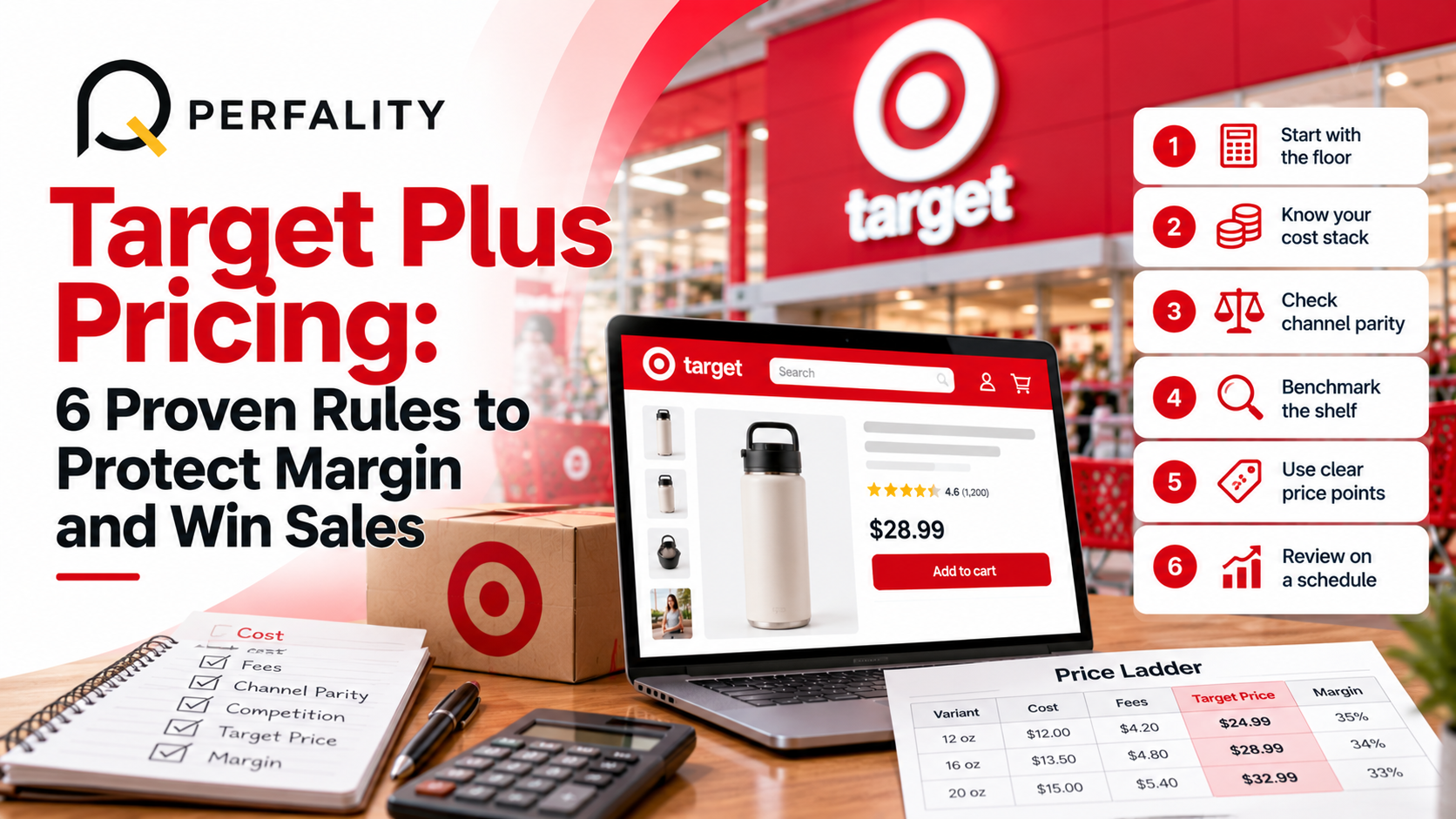
6 Proven Rules for Target Plus Pricing
Rule | What to do | Risk if ignored |
1. Start with the floor | Calculate the lowest price that still earns your target profit | Selling at a loss without noticing |
2. Know your cost stack | Include fees, shipping, returns and marketing | Margin that looks higher than it is |
3. Check channel parity | Compare with your site, Amazon and other retailers | Complaints and partner conflict |
4. Benchmark the shelf | Review comparable products on Target | A price that feels out of place |
5. Use clear price points | Keep a simple price ladder across variants | Confusing choices |
6. Review on a schedule | Check prices weekly and after cost changes | Stale prices that cost sales |
The rules for Target Plus pricing work in order. You cannot benchmark the shelf sensibly until you know your floor, and you cannot set a ladder until you know the parity rule. Treat the list as a workflow, not a menu.
Rules 1 and 2: Know the floor and the cost stack
The floor is the lowest price on Target Plus at which a sale still earns the profit you need. Work it out from the full cost stack, not just the product cost. Add the referral fee, shipping, returns allowance, integration share, insurance share and any marketing. Because the referral fee is a share of the final price, divide by one minus the fee rate, as the example later shows.
Rule 3: Check channel parity
Decide your Target Plus pricing parity rule in advance. Some brands match prices across all channels. Others allow small differences when costs differ. Whatever you choose, write it down and apply it to every product. Inconsistent exceptions become a source of confusion within weeks.
Rules 4 and 5: Benchmark the shelf and set clear price points
Browse the category as a shopper would. Note the price range, the typical pack sizes and what premium products add. Our market research service does this at scale, but even an hour of manual browsing is useful. Then set a clear ladder: a small number of price points, each with a visible reason for the step up.
Rule 6: Review on a schedule
Costs change, shipping rates change and competitors move, so Target Plus pricing must move with them. A price that was right in January can be wrong by June. Set a weekly review for your top sellers and a monthly review for the rest.
A Fictional Price Ladder for One Product
Imagine an invented brand, Harbor Brew, that sells a stainless steel travel mug. The team wants a clear structure for Target Plus pricing across three sizes, so it can price on Target Plus without guessing. The table shows the logic.
Size | Cost before fee | Floor at 12% fee | Planned price |
12 oz | $11.00 | $12.50 | $16.99 |
16 oz | $12.50 | $14.20 | $19.99 |
20 oz | $14.00 | $15.91 | $22.99 |
The floor is the cost divided by 0.88, which covers the assumed 12% fee, with no profit. The planned price leaves room for profit and promotions. Each size steps up by about three dollars, which makes the ladder easy to understand. The fee rate and all numbers are fictional, so replace them with your own.
Notice what the ladder does. It protects margin on every size, it gives a customer a clear reason to move up and it leaves a gap between floor and price for a discount when a promotion makes sense. If the planned price ever drops near the floor, the brand knows to stop, not to guess.
How to Price on Target Plus Without Starting a Price War
A price war is rarely a decision, and it is the enemy of good Target Plus pricing. It happens when each seller reacts to the last cut. You can avoid it by differentiating on things that cost less than a discount.
- Bundles: sell a set at a clear saving, which raises order value without cutting unit price.
- Content: better images and descriptions justify a higher price.
- Delivery: fast, reliable shipping is a reason to pay more.
- Service: quick answers and easy returns build loyalty.
- Exclusivity: offer a colorway or pack size unavailable elsewhere.
When you do need to lower a price, set a limit and an end date. Open-ended discounts tend to become permanent, because customers adjust their expectations quickly.
What a Promotion Does to Target Plus Pricing Margin
Discounts feel small until you run the numbers. Using the fictional 12 oz mug, the table shows what a 15% promotion does to profit, assuming the same 12% fee and an all-in cost of $11.00.
Line | Planned price | 15% promotion |
Selling price | $16.99 | $14.44 |
Referral fee at 12% | $2.04 | $1.73 |
Cost stack | $11.00 | $11.00 |
Profit per unit | $3.95 | $1.71 |
Profit as share of price | 23.2% | 11.8% |
A 15% discount cuts profit per unit by more than half, because costs do not shrink when the price does. The brand would need to sell more than twice as many units to earn the same profit. That is a useful test before any promotion: how much extra volume must it bring to break even?
Run this check on every discount idea. If the volume needed is unrealistic, choose a different tool, such as a bundle or a better main image. Disciplined Target Plus pricing treats a promotion as an investment with a measurable return.
Common Mistakes When You Price on Target Plus
- Copying the Amazon price without recalculating the fee and shipping stack.
- Setting the price once and never reviewing it after a cost change.
- Ignoring the referral fee when calculating margin, so the real profit is lower than planned.
- Letting repricing software run with no floor.
- Offering different prices in different channels without a written reason.
Each mistake comes from the same habit: treating the price as a guess instead of a calculation. A one-page pricing sheet for each product, updated monthly, removes most of them. If you plan to price on Target Plus at scale, build that sheet before you build the catalog.
Repricing Rules for Target Plus Pricing After Launch
Many sellers use software or simple rules to adjust Target Plus pricing. Rules save time, but they can also cause damage if they run unchecked. A good repricing setup has limits, alerts and a human review.
Control | What it does | Example |
Price floor | Prevents any price below your minimum | Never below the calculated floor |
Price ceiling | Stops runaway increases | No more than a set percentage above planned price |
Change limit | Caps how much a price can move in a day | No more than one change per day |
Alert | Flags large moves for a person to check | Email when a price moves by more than a set amount |
Parity check | Compares with other channels | Warn if the gap exceeds the agreed range |
Our guide on Buy Box monitoring describes how we watch price and stock together on other marketplaces, and the same discipline applies to Target Plus pricing. A price that is correct but out of stock still loses the sale.
For a wider view of the competition, see how a marketplace intelligence system gathers price and availability data across channels. You do not need a large system to start. A weekly check of your top twenty products will already reveal most problems.
Who Should Own Pricing Decisions
Pricing often falls between teams. Finance owns the margin, sales owns the channel and operations owns the cost data. When no one owns the final number, prices drift. Name one person who approves changes and one who maintains the pricing sheet.
Give that owner clear authority within limits. For example, allow changes up to a set percentage without approval and require a second sign-off beyond it. This keeps decisions fast while protecting the floor, and it makes every price change traceable if a question comes up later.
Meet briefly each week to review exceptions, upcoming cost changes and promotion plans. Fifteen minutes is enough when the data is ready, and it prevents the slow slide into inconsistent prices.
Promotions and Discounts on Target Plus
Promotion rules affecting Target Plus pricing are part of your agreement, so confirm what Target allows before you plan an event. In general, treat promotions as scheduled projects, not as emergency fixes. Decide the goal, the product list, the maximum discount and the end date, then measure the result.
- Pick products with room to discount. Choose items whose margin can handle the discount.
- Check stock. A promotion that runs out of inventory harms reviews and rank.
- Set the floor in advance. Never go below your calculated minimum.
- Measure the whole result. Count units, profit and returns, not just revenue.
- End on time. Return to the planned price on the planned day.
- Cost stack calculated for every SKU
- Floor price set at your target profit
- Channel parity rule written down
- Comparable Target products reviewed
- Price ladder defined for variants
- Repricing limits, alerts and review set
- Promotion plan with floor and end date
How Perfality Supports Your Target Plus Pricing
Pricing is a data problem as much as a judgment problem. For Target Plus pricing we typically help with:
- Cost-stack modeling that sets a safe floor price for every product.
- Cross-channel price checks that flag gaps before customers notice.
- Category benchmarking so you know how to price on Target Plus relative to comparable items.
- Daily monitoring of price and stock errors across your catalog.
- Ongoing store handling through our Target Plus marketplace management
The aim is a price that wins the sale and still pays you for the work.
Related Services
If you want help to price on Target Plus and keep prices consistent across channels, our team can help. For the full picture of what we do for sellers and suppliers working with Target, see our Target Plus marketplace management service. Depending on where this issue keeps recurring, this is the kind of support that typically helps:
- Full-service Amazon management: Full Service Amazon Management, Full Service Amazon Agency, Amazon Full Service Agency, Full Service Amazon Marketing Agency, Best Full-Service Amazon Agency, Best Full Service Amazon Agency
- FBA-focused support: Amazon FBA Management Agency, Amazon FBA Agency, Amazon FBA Marketing Agency, Amazon FBA Management Service
- Listing and content optimization: Amazon Listing Optimization Services, Amazon Listing Optimization Agency, Amazon Listing Optimization Service, Amazon Product Listing Optimization Service, Amazon Product Listing Optimisation Service, Amazon Product Listing Optimisation Service USA
- Product listing services: Amazon Product Listing Service, Amazon Product Listing Service Provider, Best Amazon Product Listing Service Agency
- PPC and advertising management: Amazon PPC Management Service, Amazon PPC Management Service Agency, Best Amazon PPC Management Service, PPC Management Service For Amazon
- Account management: Best Amazon Account Management Services, Amazon Ecommerce Company
If this is a recurring pain point rather than a one-off, it’s usually worth a quick conversation. Book a free 30-minute call with our team and we’ll walk through what’s actually happening on your account.
Frequently Asked Questions
Start with a floor price from your full cost stack, check parity with your other channels, benchmark comparable Target products and build a simple price ladder. Review prices on a set schedule.
Your agreement and your own channel strategy decide that. Many brands aim for parity to avoid complaints, but confirm Target’s current pricing policy before you set a different price.
Only with a plan. Set the products, maximum discount and end date, check stock and measure profit, not just revenue. Confirm Target’s promotion rules first.
Have any questions? Let’s connect!