




- Perfality
- October 27, 2026
- 2:31 pm
- Read Time: 10 mintues
Brands that already sell on Amazon often ask the same question when Target comes up: is it worth the effort? The honest answer in a Target Plus vs Amazon comparison is that they are different kinds of channel. One is open, huge and highly competitive. The other is curated, smaller and selective.
This Target Plus vs Amazon guide compares the two across eight differences, shows a fictional brand deciding where to put its effort and offers a simple scoring method you can reuse. It also covers how to run both without doubling your workload. Target’s seller terms are shared with approved sellers, so details about the Target Plus marketplace come from third-party guides. Confirm them with Target before you decide.
Two Very Different Kinds of Marketplace
Amazon is an open marketplace. Almost any qualified seller can open an account, list products and start selling within days. That openness is its strength and its challenge, because shoppers see many sellers for the same item and compete on price, reviews and advertising.
The Target Plus marketplace works the other way. Guides describe it as invite-only, U.S.-focused and limited to vetted sellers. There is a smaller set of sellers on the shelf, which can mean less direct competition, but there is also no guarantee you will be accepted.
So the real question in Target Plus vs Amazon is not which is better. It is which fits your brand today, and whether you can run both well.
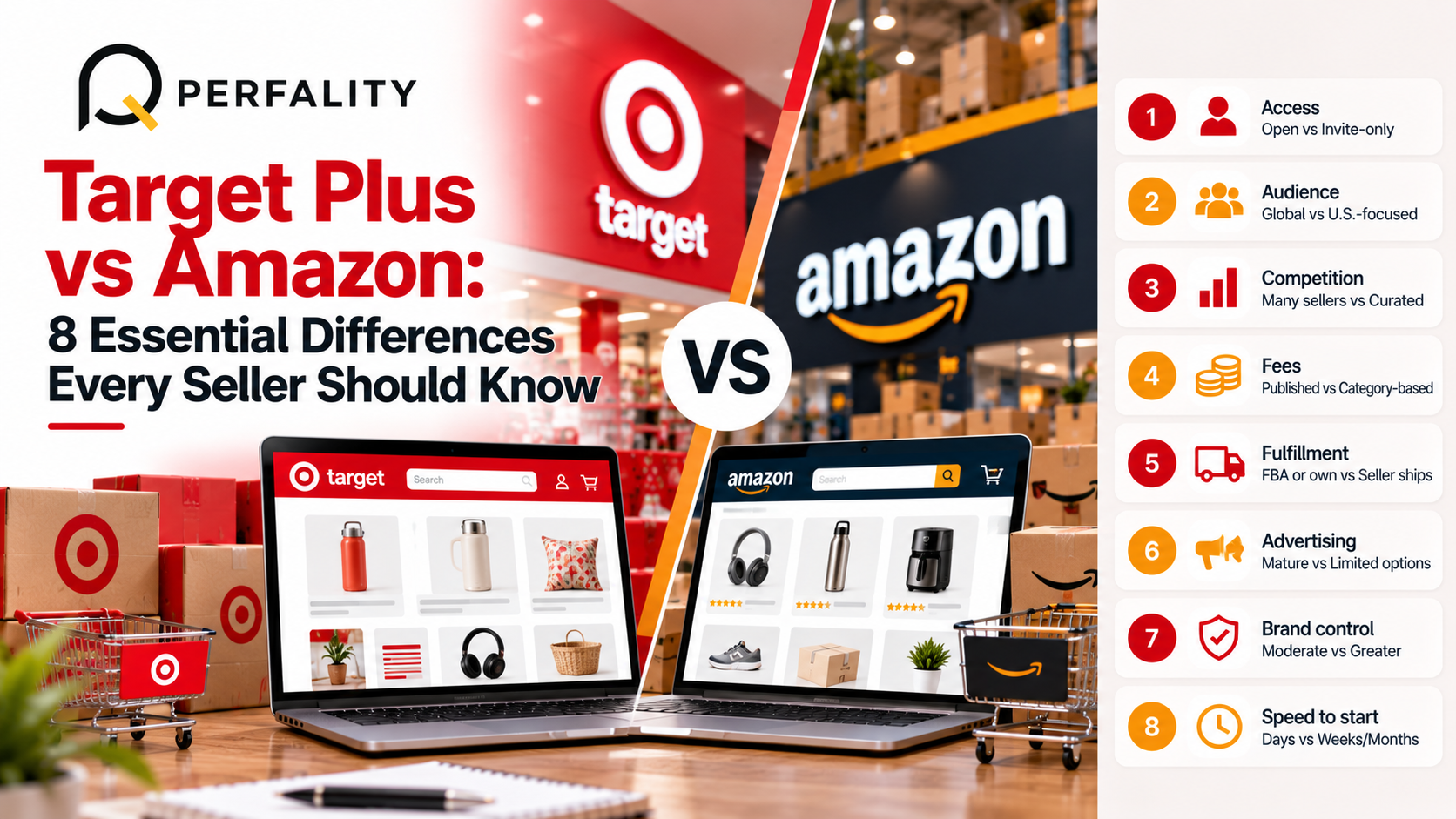
Target Plus vs Amazon: 8 Essential Differences
Area | Amazon | Target Plus (per third-party guides) |
Access | Open to qualified sellers | Invite-only, with an application form and no guaranteed reply |
Audience | Very large, global reach | Target guests, mainly in the U.S. |
Competition | Many sellers per product | Curated, with fewer sellers |
Fees | Published referral and fulfillment fees | Category-based fees shared with approved sellers |
Fulfillment | FBA or your own | Seller ships from the U.S.; guides say Amazon FBA cannot be used |
Advertising | Mature sponsored ads system | Options exist but details vary, so confirm with Target |
Brand control | Moderate, with shared listings | Greater, with a curated look |
Speed to start | Days to weeks | Weeks to months, if accepted |
Because the Target Plus vs Amazon table relies on third-party sources for Target, treat the right-hand column as a starting point. Amazon’s published policies are easier to verify, but they also change often.
Access and speed to start
On Amazon, you can be live quickly. On Target Plus, the invitation step alone can take weeks or longer, and some applicants never hear back. If you need revenue in the next month, Amazon is faster. If you are building a long-term brand, the wait may be worth it.
Audience and competition
Amazon offers scale. Target Plus offers a different shopper: someone who likes Target’s style and trusts its brand. Fewer sellers per category can help new products stand out, though the total volume is generally smaller.
Fulfillment and control
Amazon sellers can hand fulfillment to FBA. Guides say that is not allowed for Target orders, so you need your own U.S. fulfillment plan. On the other hand, you keep more control of presentation, and the page tends to look more like your brand.
A Fictional Brand Choosing Between Them
Consider an invented brand, Alder & Ash, that sells premium candles. It makes $1.5 million a year on Amazon and its own site. It has been invited to apply to the Target Plus marketplace and wants to know whether to proceed.
Question | Answer for Alder & Ash | Effect on the decision |
Do we have spare fulfillment capacity? | Yes, a 3PL with room | Favors starting |
Do we have the team to manage another channel? | Not yet | Delay or hire help |
Is our brand a good fit for Target guests? | Yes, home and gift | Favors starting |
Are our margins healthy after fees? | Yes, with a 40% gross margin | Favors starting |
Could the effort hurt Amazon performance? | Possibly, if the team is stretched | Needs a plan |
The brand decides to proceed, but only after hiring support for daily order checks and customer messages. It keeps Amazon as its main engine and treats Target Plus as a second channel to be built carefully. The scenario is fictional, yet the reasoning is common: capacity and fit decide, not hype.
A Simple Scoring Method for Target Plus vs Amazon
You can make Target Plus vs Amazon more objective with a short score. Rate each channel from 1 to 5 on the five factors below, then multiply by the weight that reflects your priorities. The channel with the higher total is where to put your next hour of effort.
Factor | Weight | Questions to ask |
Revenue potential | 30% | How much can this channel realistically add in a year? |
Margin | 25% | After fees, shipping and returns, what is left? |
Effort | 20% | How many hours a week will the channel need? |
Brand fit | 15% | Does the channel match how we want the brand to look? |
Risk | 10% | What could go wrong, and how bad would it be? |
The weights are only an example, so change them to match your goals. A brand that values control may raise brand fit, while one that needs cash may raise revenue. The value of the exercise is in the conversation it forces, not the final number.
Is the Target Plus Marketplace Right for Your Brand?
Before you finish a Target Plus vs Amazon comparison, test your brand against four traits that tend to match the Target Plus marketplace. None is a rule from Target. They are patterns that third-party guides and sellers describe.
Trait | Good sign | Warning sign |
Brand ownership | You own or control the brand | You resell labels owned by others |
Differentiation | A clear point of difference | Products that copy what Target already sells |
Operations | U.S. fulfillment and strong service | Slow shipping or thin support |
Data | Clean catalog with valid barcodes | Missing GTINs and inconsistent content |
If you see mostly good signs, the Target Plus marketplace may suit you. If you see warning signs, fix them first. They will also improve your Amazon results, so the work is useful either way.
A Fictional Margin Comparison: Target Plus vs Amazon
Margins decide whether a channel is worth the effort. The table compares a fictional $30 product on both channels using invented cost assumptions. It is only a model, so replace each number with your own. Real Target Plus vs Amazon results depend on your category, fees and shipping.
Per unit | Amazon (FBA) | Target Plus (own fulfillment) |
Selling price | $30.00 | $30.00 |
Referral fee (assumed) | $4.50 (15%) | $3.60 (12%) |
Fulfillment and shipping | $5.50 | $6.50 |
Product cost | $10.00 | $10.00 |
Advertising | $3.00 | $1.50 |
Profit per unit | $7.00 | $8.40 |
In this invented example the Target Plus marketplace earns more per unit, but that depends on lower advertising and the assumed fee. If volume on Target is a fraction of Amazon’s, total profit can still be lower. The lesson is to compare both profit per unit and total units before you decide.
Questions Sellers Ask About Target Plus vs Amazon
After reading dozens of seller discussions, a few questions repeat. The answers below are general, because Target’s own terms are shared only with approved sellers.
- Will Target Plus cannibalize Amazon sales? Sometimes, but a different shopper base usually adds more than it takes.
- Do I need different listings? Yes, adapt tone, images and titles to a more curated style.
- Is advertising required? Not necessarily, but ask Target which options exist for your category.
- How much time does the Target Plus marketplace need? Plan for daily order and message checks, not occasional visits.
Whatever you choose, write the decision down with the date and the reasons. When circumstances change, you can review the logic instead of starting from scratch. A clear record turns each Target Plus vs Amazon choice into something you can improve over time.
How to Run Both Without Doubling Your Workload
Selling on two channels sounds like twice the work, and Target Plus vs Amazon choices often stall for that reason, but much of it is shared. The trick is to build one master process and adapt it, not to run two separate businesses.
- One master catalog: store titles, images, dimensions and barcodes in a single clean source.
- One pricing sheet: track cost, floor and planned price per channel in the same file.
- One inventory view: know how much stock is allocated to each channel, especially because FBA stock cannot serve Target orders.
- One reporting dashboard: compare sales, returns and profit side by side.
- One owner per channel: someone accountable for results and for daily checks.
Our article on data standardization explains why a single clean catalog makes every new channel easier to add. Teams that skip this step usually end up fixing the same errors twice.
What Sellers Often Get Wrong in a Target Plus vs Amazon Decision
- Treating Target Plus as a copy of Amazon and reusing listings without adjusting tone and images.
- Moving effort away from Amazon before Target produces revenue.
- Ignoring the cost of building a separate fulfillment path.
- Expecting fast results from an invite-only channel.
- Assuming Amazon fees and Target fees are comparable without checking the full cost stack.
A calmer approach to Target Plus vs Amazon is to protect your main channel, add Target Plus gradually and review results quarterly. A retail data analytics dashboard makes the comparison easier, because you can see profit by channel instead of relying on instinct.
A 12-Month View of Target Plus vs Amazon
Think of the decision as a twelve-month plan, not a one-day choice. Amazon is your base. Target Plus becomes a project with its own milestones, and you review it with the same rigor you apply to any investment.
Quarter | Focus | Check |
Q1 | Fix catalog, barcodes and fulfillment plan; request an invitation | Readiness score rises |
Q2 | Integrate, load a small product set and test orders | Clean pilot with few errors |
Q3 | Add products and tune pricing and content | Profit per unit holds |
Q4 | Prepare for peak season and review the channel | Decide whether to scale |
At the end of the year, compare real profit by channel. If Target Plus is earning, scale it. If not, find out why before putting in more effort.
When Amazon Alone Is Enough
Not every brand needs Target Plus, and the Target Plus vs Amazon answer can be Amazon alone. If your products are highly price-driven, if your margins are thin or if your team is already stretched, adding a second channel can reduce quality everywhere. A well-run Amazon business is better than two poorly run channels.
On the other hand, if you want to build brand presence, reduce reliance on a single platform or reach shoppers who prefer Target, the Target Plus marketplace deserves serious thought. Concentration risk is real, and a second channel can protect you from sudden changes on the first.
- Target Plus vs Amazon differences reviewed against your own situation
- Fulfillment plan for Target orders confirmed, separate from FBA
- Full cost stack calculated for both channels
- Weighted score completed and discussed
- One master catalog and one pricing sheet in place
- Named owner for each channel
- Quarterly review of results scheduled
How Perfality Helps You Compare and Run Both Channels
We manage marketplaces side by side, so the comparison is something we do every day. For brands weighing Target Plus vs Amazon we typically help with:
- A channel fit review that scores revenue, margin, effort, brand fit and risk.
- Cost-stack modeling for both channels, so you see profit and not just revenue.
- A master catalog and pricing sheet that serve every marketplace.
- Daily monitoring so Amazon performance stays strong while you add Target Plus.
- Ongoing store handling through our Target Plus marketplace management
The right answer is the one that grows profit without breaking what already works.
Related Services
If you are weighing Target Plus vs Amazon and want an outside view of fit and workload, our team can help. For the full picture of what we do for sellers and suppliers working with Target, see our Target Plus marketplace management service. Depending on where this issue keeps recurring, this is the kind of support that typically helps:
- Full-service Amazon management: Full Service Amazon Management, Full Service Amazon Agency, Amazon Full Service Agency, Full Service Amazon Marketing Agency, Best Full-Service Amazon Agency, Best Full Service Amazon Agency
- FBA-focused support: Amazon FBA Management Agency, Amazon FBA Agency, Amazon FBA Marketing Agency, Amazon FBA Management Service
- Listing and content optimization: Amazon Listing Optimization Services, Amazon Listing Optimization Agency, Amazon Listing Optimization Service, Amazon Product Listing Optimization Service, Amazon Product Listing Optimisation Service, Amazon Product Listing Optimisation Service USA
- Product listing services: Amazon Product Listing Service, Amazon Product Listing Service Provider, Best Amazon Product Listing Service Agency
- PPC and advertising management: Amazon PPC Management Service, Amazon PPC Management Service Agency, Best Amazon PPC Management Service, PPC Management Service For Amazon
- Account management: Best Amazon Account Management Services, Amazon Ecommerce Company
If this is a recurring pain point rather than a one-off, it’s usually worth a quick conversation. Book a free 30-minute call with our team and we’ll walk through what’s actually happening on your account.
Frequently Asked Questions
Neither is better in every case. Amazon is open and large, while Target Plus is curated and invite-only. The right choice depends on your brand, margins, fulfillment capacity and goals.
Several third-party guides say Target orders cannot be fulfilled through Amazon FBA. Plan separate U.S. fulfillment and confirm the rule with Target.
Generally yes, if your agreements allow it. The practical limit is your team’s capacity, so build a shared catalog and pricing process before adding the second channel.
Have any questions? Let’s connect!