




- Perfality
- August 24, 2026
- 6:18 pm
- Read Time: 5 mintues
Amazon Seller Flex costs get far less attention than the program’s benefits, but they’re what actually decide whether the switch pays off. Sellers hear “keep the Prime badge, skip the FBA fees” and assume the math is simple. It rarely is.
Once you look past storage savings and transportation fees, a real list of Amazon Seller Flex costs shows up, and most of it never appears in Amazon’s own program overview. This breakdown covers where the money actually goes after approval, so you can budget for the switch instead of discovering it three months in.
A Quick Recap: What Amazon Seller Flex Changes
Amazon Seller Flex lets you store inventory at your own warehouse while Amazon still handles last-mile delivery and Prime eligibility for qualifying orders. You take on picking, packing, and warehouse management; Amazon keeps the delivery network. For a full breakdown of how the program works day to day and who typically qualifies, see our companion guide on Amazon Seller Flex eligibility and operations.
That division of labor is exactly why Amazon Seller Flex costs are so easy to underestimate. You’re not just trading FBA storage fees for lower fees. You’re taking on an entire warehouse operation Amazon used to run for you.
Where Amazon Seller Flex Costs Actually Come From
The program’s marketing angle is cost savings, and for the right seller, that’s true. But the savings only materialize after you’ve absorbed a set of upfront and ongoing expenses that used to be Amazon’s problem, not yours.
It’s an Operations Shift, Not Just a Fee Change
Amazon Seller Flex costs aren’t a single line item you can compare against FBA storage fees. They’re spread across infrastructure, staffing, software, and compliance, which is why sellers who only budget for “warehouse rent” tend to get blindsided.
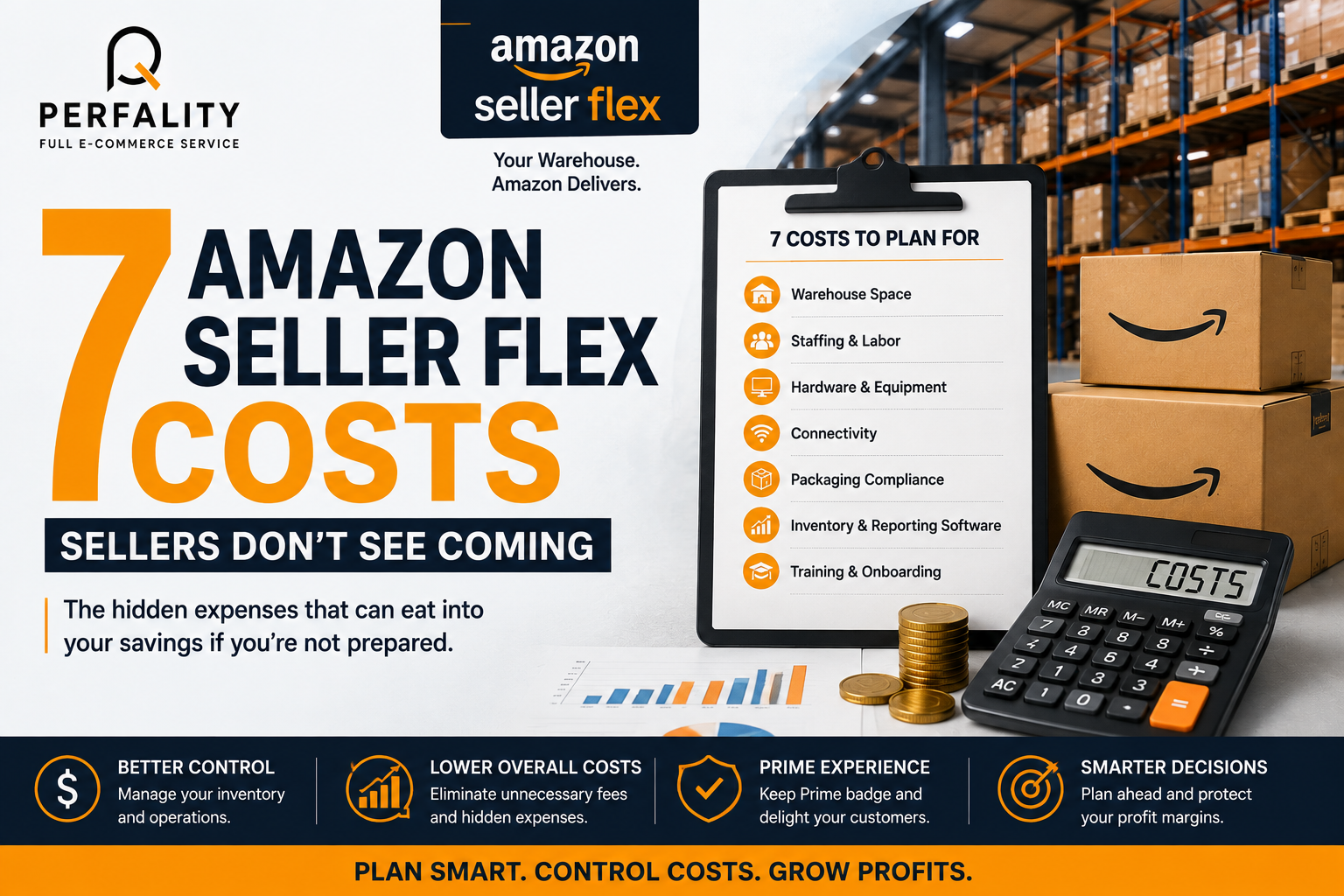
7 Amazon Seller Flex Costs to Budget For Before You Apply
Amazon’s own hardware and staffing requirements give a useful starting list. Here’s what to plan for before you submit an application or accept an invitation.
- Warehouse space — enough square footage for inventory, a dedicated packing station, and vehicle access for pickups.
- Staffing — Amazon’s baseline expectation is at least six employees to run picking, packing, and shipping reliably.
- Hardware — computers, barcode scanners, multiple printers (shipping label, gift, invoice), and a backup power supply.
- Connectivity — two stable internet connections, since a single outage can stall order processing entirely.
- Packaging compliance — Prime-eligible packaging supplies and materials that meet Amazon’s presentation standards.
- Inventory and reporting software — a system that keeps warehouse counts synced with Seller Central in near real time.
- Training and onboarding time — ramping a new warehouse team on Amazon’s specific pick-and-pack and labeling requirements.
Add these up and the entry cost looks a lot less like “switching a shipping setting” and a lot more like standing up a small fulfillment center.
Hidden Amazon Seller Flex Costs That Show Up Later
The startup list above is only half the picture. A second wave of Amazon Seller Flex costs tends to appear a few months into the program, once volume ramps up and Amazon starts holding you to its performance standards.
- Inventory discrepancies — inaccurate counts lead to overselling, order cancellations, and account health flags.
- Customer service load — returns, damage claims, and delivery issues now route through your team, not Amazon’s.
- Staffing turnover — six employees is a baseline, not a buffer, so coverage gaps during peak periods get expensive fast.
Reporting gaps — without a daily view of orders, exceptions, and shipment status, small problems compound before anyone notices.
Amazon Seller Flex Costs vs. FBA Fees: Running the Real Comparison
The only honest way to evaluate Amazon Seller Flex costs is to compare the full operating cost of your own warehouse against your actual FBA fee history, not a generic industry estimate. Pull your last two or three months of FBA fulfillment and storage fees as the baseline.
Then price out warehouse space, staffing, hardware, software, and packaging at your real local rates, not Amazon’s example figures. If the total comfortably undercuts your FBA fees and you have the volume to keep a six-person team busy, the case is worth pursuing. If the numbers are close, the operational risk usually isn’t worth the marginal savings.
How to Keep Amazon Seller Flex Costs Under Control
Controlling Amazon Seller Flex costs is less about cutting corners and more about connecting the parts of the account that influence each other. An experienced Amazon FBA Management Agency can help structure the warehouse-to-Seller-Central workflow so inventory issues get caught before they trigger cancellations or account health problems.
For sellers who don’t want to build this in-house, working with an Amazon FBA Agency, an Amazon FBA Management Service, or an Amazon FBA Marketing Agency can shorten the learning curve considerably. A Full Service Amazon Management partner, an Amazon Full Service Agency, or a Full Service Amazon Agency can typically fold Seller Flex oversight into the same reporting cadence used for the rest of the account, rather than treating it as a separate project. Sellers comparing providers often look for one of the Best Amazon Account Management Services on the market, since Seller Flex oversight works best as part of a broader account relationship rather than a one-off engagement.
Don’t Let Listings and PPC Drift While Costs Are Front of Mind
It’s easy to get so focused on Amazon Seller Flex costs that catalog and advertising quality slip. Strong Amazon Listing Optimization Services and an ongoing Amazon Listing Optimization Service keep conversion rates steady while the fulfillment model changes underneath them. An Amazon Listing Optimization Agency or Amazon Product Listing Optimization Service can handle this at scale across a large catalog.
For US-based catalogs specifically, an Amazon Product Listing Optimisation Service USA can maintain content consistency, while an Amazon Product Listing Optimisation Service or Amazon Product Listing Service handles ASIN-level fixes as inventory shifts. Larger sellers often lean on an Amazon Product Listing Service Provider or a Best Amazon Product Listing Service Agency to keep pace with volume.
Advertising should follow the same discipline. An Amazon PPC Management Service, Amazon PPC Management Service Agency, or PPC Management Service For Amazon should adjust spend based on what the new warehouse setup can actually fulfill — the Best Amazon PPC Management Service is the one that treats inventory and ad spend as connected, not separate.
Amazon Seller Flex Costs Checklist
Run through this before you apply or before you scale an existing Seller Flex operation.
- Compare three months of real FBA fees against a fully priced warehouse operating budget.
- Confirm hardware, connectivity, and backup power meet Amazon’s stated requirements.
- Staff for at least six roles, plus coverage for peak periods and absences.
- Set up daily inventory and exception reporting before volume ramps up.
- Review top ASINs for listing accuracy so conversion doesn’t dip during the transition.
- Align PPC budgets with what the warehouse can currently fulfill.
Revisit the cost comparison quarterly, not just at launch
Getting the Full Picture Before You Commit
Amazon Seller Flex costs aren’t a reason to avoid the program. For the right seller, with the right volume and warehouse discipline, they’re simply the price of more control. The mistake is assuming the savings are automatic instead of running the comparison honestly.
Whether you’re weighing a Best Full-Service Amazon Agency, a Best Full Service Amazon Agency, or a Full Service Amazon Marketing Agency to help manage the transition, the same question applies: can they show you the real numbers behind Amazon Seller Flex costs, not just the pitch behind the program.
Perfality works with sellers evaluating fulfillment changes alongside listings, advertising, and account health. Explore our e-commerce management services or book a 30-minute strategy call to walk through your own Amazon Seller Flex costs before you apply.