




- Perfality
- September 17, 2026
- 4:56 pm
- Read Time: 10 mintues
Every day a suppressed listing stays down compounds the loss — lost sales, lost search ranking, and momentum that doesn’t come back automatically once the listing is reinstated. The single biggest time sink in recovery isn’t the fix itself; it’s figuring out which of several possible causes actually triggered the suppression in the first place.
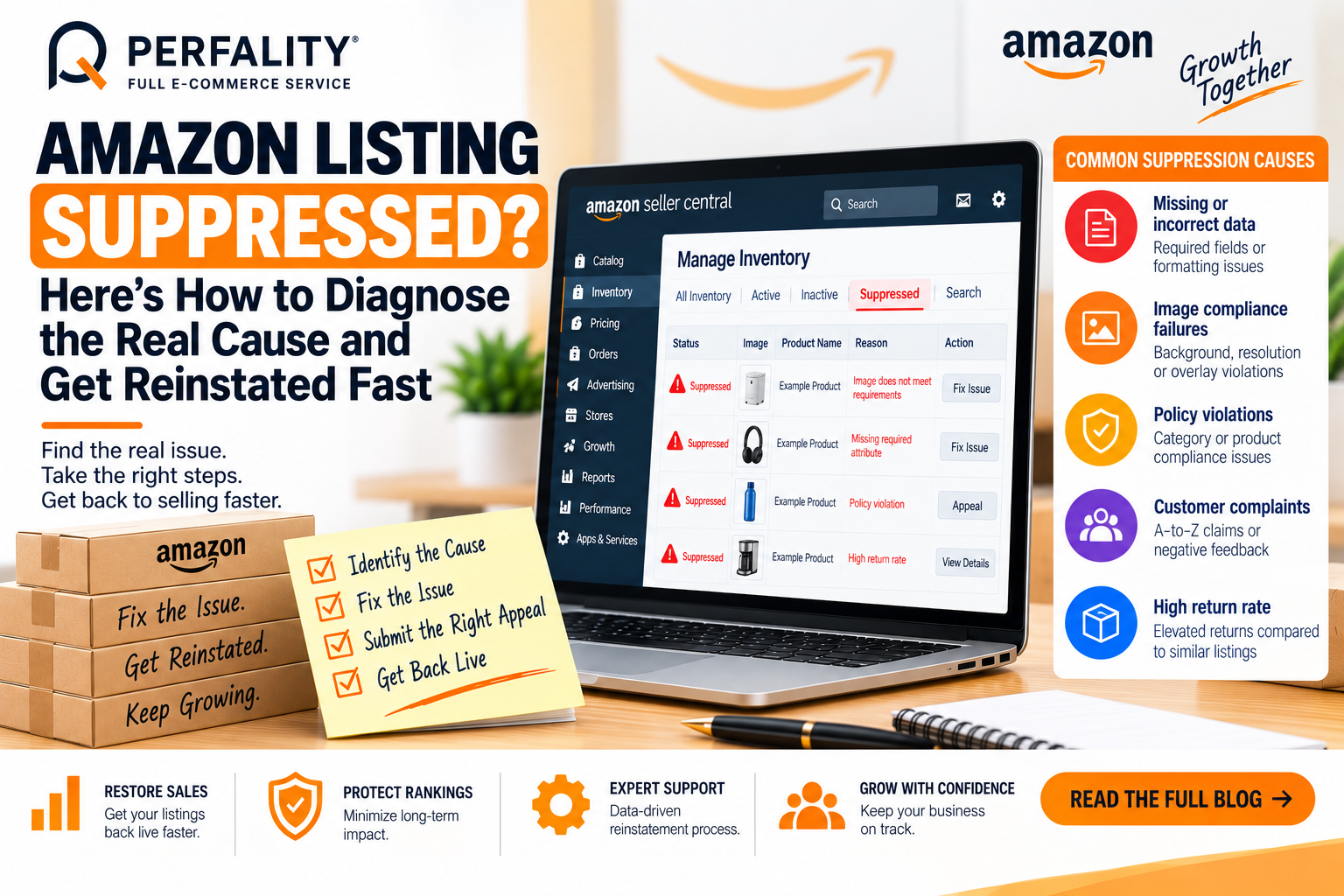
Account Health dashboards don’t always make the specific trigger obvious at a glance, which is exactly why a fast, structured diagnosis matters more than reacting immediately. And the cause isn’t always something in the listing itself — a rising return rate or a cluster of customer complaints on one ASIN can trigger suppression just as easily as a content or image error.
The Five Most Common Suppression Triggers
- Missing or malformed catalog data — a required field left blank or formatted incorrectly.
- Image compliance failures — background, frame fill, resolution, or overlay violations.
- A policy violation notice tied to a specific compliance issue.
- A spike in customer complaints or A-to-Z claims tied to the specific ASIN — not an account-wide issue, but enough negative signal on one listing to trigger an automatic review.
- An elevated return rate on that ASIN relative to similar listings, which Amazon treats as a standalone product-quality signal independent of the Voice of the Customer score.
Amazon Listing Suppression Reinstatement: Diagnose Before You Act
Manage Inventory’s “Suppressed” tab shows the exact error code behind a suppression, and it’s worth checking there first rather than assuming the cause. Each error code maps to a specific trigger, and treating them all the same way wastes the time that reinstatement speed actually depends on.
Complaint- and return-driven suppressions look different from a data or image error: the listing itself may be fully compliant, but the return rate report or the customer complaint history under Voice of the Customer will show the real pattern. Pull both before assuming the problem is in the listing content.
How to Get Reinstated Faster
- Fix missing or malformed data immediately once identified — this is often the fastest reinstatement path.
- For a policy notice, read it fully and submit a precise Plan of Action rather than a generic one, since vague appeals are the most common reason a first appeal fails.
- For image-related suppression, run the listing’s main image through the standard compliance checklist before resubmitting.
- For a complaint- or return-driven suppression, pull the return reason codes first — if returns cluster around a specific complaint (wrong size, damaged in transit, not as described), the Plan of Action needs to address that root cause directly, not just state that the listing will be reviewed.
- Where returns trace back to a packaging or fulfillment issue rather than the product itself, document that distinction clearly in the appeal, since Amazon treats a fulfillment-caused return differently from a product-quality one.
- Monitor Account Health, return rate, and Voice of the Customer dashboards regularly so future suppressions are caught within hours, not discovered days later through a sales drop.
How Perfality Approaches This
Reinstatement work for client accounts follows a fixed sequence: diagnose the exact cause first, fix that specific trigger, then confirm the fix actually held. In practice:
- Suppression code pulled first: the exact error code is retrieved from Manage Inventory before any response is drafted, since a targeted fix based on the real cause moves faster than a broad appeal covering every possible reason at once.
- Return and complaint data reviewed for CX-driven suppressions: return reason codes and A-to-Z claim details are pulled before writing the Plan of Action, since Amazon’s reviewers respond better to an appeal naming the actual root cause — a sizing chart gap, a packaging issue, a fulfillment delay — than one that simply promises a listing review.
- Root-cause fix, not just a reinstatement request: a data error gets corrected in the source template so it doesn’t recur across the catalog, rather than fixed on the one flagged SKU alone.
- Fulfillment-vs-product distinction documented in the appeal: where a return traces back to shipping damage or a fulfillment delay rather than the product itself, that distinction is stated explicitly, since Amazon treats the two causes differently.
- Post-reinstatement monitoring: once a listing is back live, the underlying metric (return rate, complaint volume) gets tracked for several more weeks to confirm the fix held rather than just temporarily masking the problem.
Related Services
Because a suppression can trace back to data, images, compliance, or customer signals, recovery usually goes faster with someone who already has visibility across all four areas rather than troubleshooting each one from scratch. Treating reinstatement as an urgent but structured process — diagnose, fix the root cause, confirm it held — tends to get listings back live faster than reacting to the suppression alone.
Depending on how you’re searching, this kind of support is also known by these names:
- Full-service Amazon management: Full Service Amazon Management, Full Service Amazon Agency, Amazon Full Service Agency, Full Service Amazon Marketing Agency, Best Full-Service Amazon Agency, Best Full Service Amazon Agency
- FBA-focused support: Amazon FBA Management Agency, Amazon FBA Agency, Amazon FBA Marketing Agency, Amazon FBA Management Service
- Listing and content optimization: Amazon Listing Optimization Services, Amazon Listing Optimization Agency, Amazon Listing Optimization Service, Amazon Product Listing Optimization Service, Amazon Product Listing Optimisation Service, Amazon Product Listing Optimisation Service USA
- Product listing services: Amazon Product Listing Service, Amazon Product Listing Service Provider, Best Amazon Product Listing Service Agency
- PPC and advertising management: Amazon PPC Management Service, Amazon PPC Management Service Agency, Best Amazon PPC Management Service, PPC Management Service For Amazon
- Account management: Best Amazon Account Management Services, Amazon Ecommerce Company
Frequently Asked Questions
Check the “Suppressed” tab in Manage Inventory, which shows the exact error code behind the suppression. Each code maps to a specific trigger, such as missing data, an image violation, or a policy issue.
Yes. An elevated return rate relative to similar listings is treated as a standalone product-quality signal by Amazon, separate from the Voice of the Customer score, and can trigger suppression on its own.
It varies by cause. Data or image-related suppressions are often resolved within a day or two once fixed, while policy violations or complaint-driven suppressions can take longer, especially if the first Plan of Action isn’t specific enough.
If this is a recurring pain point rather than a one-off, it’s usually worth a quick conversation. Book a free 30-minute call with our team and we’ll walk through what’s actually happening on your account.
Have any questions? Let’s connect!