




- Perfality
- October 27, 2026
- 5:00 pm
- Read Time: 10 mintues
Approval is exciting, and it is also where many brands lose their footing. They rush to list everything, discover errors in public and spend the next month fixing problems that a calmer start would have avoided. A Target Plus launch plan prevents that by giving every week a job.
This guide lays out a 90-day roadmap in three phases, with a fictional brand following it week by week. If you are about to launch on Target Plus, use this Target Plus launch plan as a template and adjust the timing to your catalog. Target’s onboarding steps are shared with approved sellers, so the details below combine third-party guidance with general marketplace practice. Follow Target’s instructions wherever they differ.
Why Every Brand Needs a Target Plus Launch Plan
Launching a marketplace store involves more moving parts than most teams expect, which is why a Target Plus launch plan matters. Catalog data, integration, fulfillment, customer service, pricing and reporting all have to work together on the first order. A missing piece in one area shows up as a problem in another.
A written Target Plus launch plan gives you three things. It sets the order of work, so you do not build advanced features before the basics. It names owners, so tasks do not fall between people. And it creates checkpoints, so you know when to move forward and when to wait.
The Target Plus launch plan below assumes you have already received approval and have a rough integration route in mind. If you are still earlier in the journey, start with a readiness check and come back here when your invitation arrives.
The Three Phases of a Target Plus Launch Plan
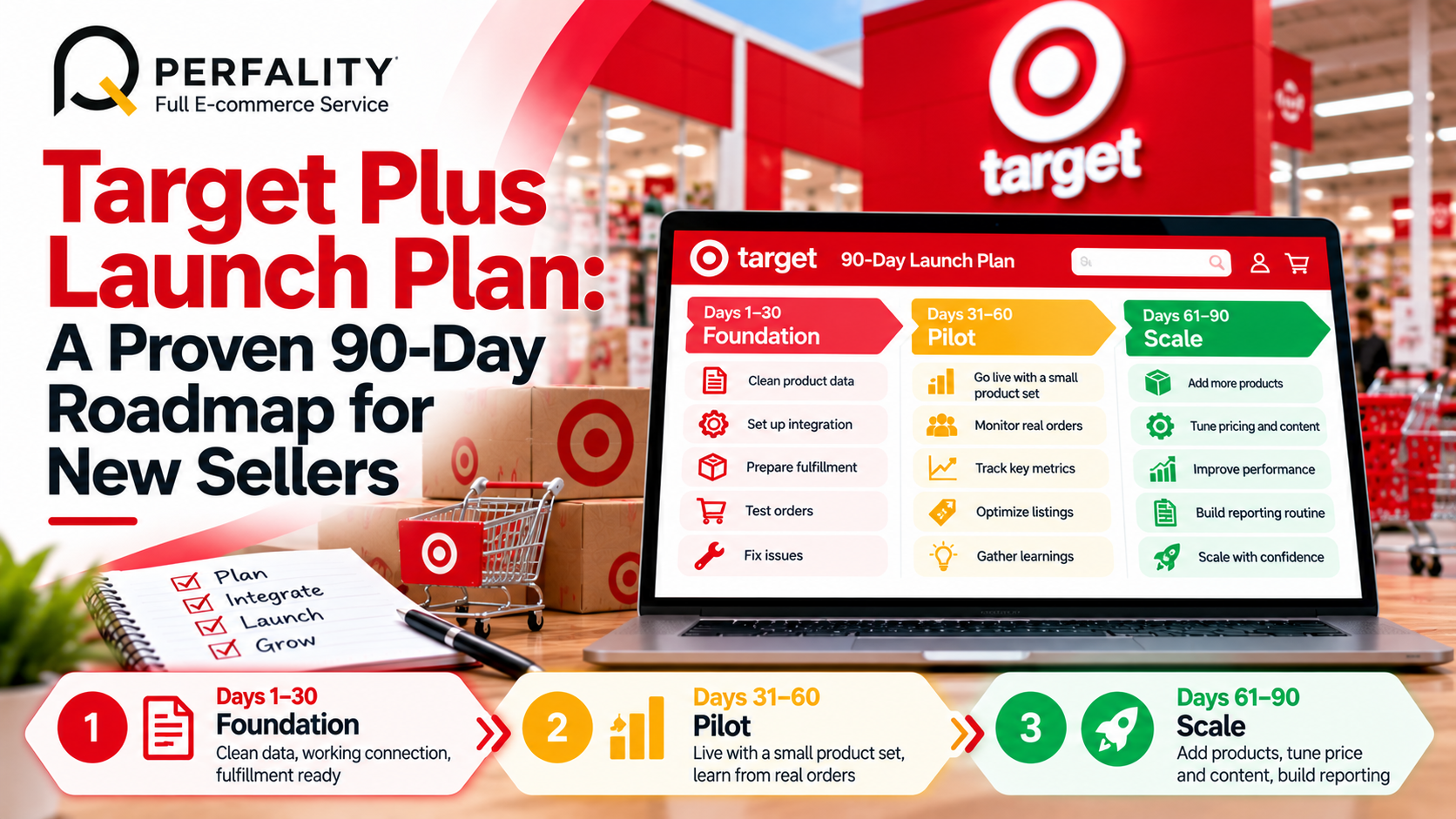
Phase | Days | Goal | Exit check |
1. Foundation | 1 to 30 | Clean data, working connection, fulfillment ready | A test order flows end to end |
2. Pilot | 31 to 60 | Live with a small product set, learn from real orders | Metrics inside your working targets |
3. Scale | 61 to 90 | Add products, tune price and content, build reporting | A repeatable weekly routine |
Each phase of the Target Plus launch plan ends with a check. Do not move on until the check is passed, even if the calendar says it is time. A late start on the next phase costs far less than a messy one.
Phase 1: Foundation
The first month of your Target Plus launch plan is about preparation. Finish the catalog, test the connection and confirm fulfillment. Fix barcodes, titles and images now, because errors multiply once products are live. Our guide on data standardization shows how to set one format across the range.
Phase 2: Pilot
In the second month of the Target Plus launch plan, go live with a small product set, often ten to twenty items. Choose your cleanest, best-stocked products with healthy margins. Watch every order closely. The pilot is where you learn how the process works in practice.
Phase 3: Scale
In the third month of the Target Plus launch plan, add products in batches, tune pricing and content and build the reporting routine. The goal is a store that runs on habits, not heroics.
A Fictional 90-Day Example
Meet an invented brand, Fernhill Pet, that sells pet accessories and has just been approved for the marketplace. Its team has two people on e-commerce and a third-party warehouse. The table shows how it used the plan.
Weeks | Focus | Result |
1 to 2 | Audit catalog, fix 18 missing barcodes, choose the integration route | Clean data for 40 products |
3 to 4 | Connect systems, run test orders, confirm warehouse labels | One full test order completed |
5 to 6 | Go live with 12 products and watch orders daily | First real orders shipped on time |
7 to 8 | Fix two content issues found in the pilot, review returns | Pages improved before scaling |
9 to 10 | Add 18 more products in two batches | Full 30-product range live |
11 to 12 | Tune pricing, build the weekly scorecard, plan peak season | A stable routine and a clear next step |
The numbers in this Target Plus launch plan example are invented, but the rhythm is realistic. Notice that the brand did not go live until week five, and it added most of its range only after the pilot. A slower start gave it a cleaner record.
Weekly Milestones for Your Target Plus Launch Plan
Break each phase of your Target Plus launch plan into weekly goals. Weekly milestones keep the team focused and make delays obvious early. Adapt the list below to your own catalog and team.
- Week 1: Audit. Review every product for barcodes, titles, images and attributes.
- Week 2: Decide. Choose your integration route, owner and fulfillment partner.
- Week 3: Connect. Build the connection and map your fields.
- Week 4: Test. Run test orders, tracking uploads and returns.
- Week 5: Go live. Publish a small product set and check every order.
- Weeks 6 to 8: Learn. Fix issues, review metrics and talk to your customers.
- Weeks 9 to 12: Grow. Add products, tune prices and finalize reporting.
Review progress every Friday for fifteen minutes. If a milestone slips, decide whether to extend the deadline or reduce the scope. Never let a slip pass silently.
What to Prepare Before You Launch on Target Plus
Some tasks are best finished before you launch on Target Plus. They are small, but each one can cause a visible problem if skipped. Use the table as a pre-flight check.
Area | Preparation | Owner |
Catalog | Valid GS1 barcodes, clean titles, final images | Content lead |
Integration | Tested feeds for catalog, stock, orders and tracking | Operations lead |
Fulfillment | Stock in place, labels tested, packaging checked | Operations lead |
Pricing | Floor, ladder and parity rule agreed | Channel manager |
Service | Reply templates, return process and response goal | Service lead |
Reporting | Scorecard built with owners and thresholds | Channel manager |
If any row is incomplete, decide whether the gap is small enough to launch with, or whether it should delay the pilot. A short delay is cheaper than a public mistake.
How to Choose Pilot Products in Your Target Plus Launch Plan
The pilot set is the most important choice in the plan. The right products produce clean data and early wins. The wrong ones produce returns and cancellations that overshadow everything else. Score each candidate on five simple criteria.
Criterion | Question | Score 2 means |
Data quality | Is the content complete and the barcode valid? | Nothing is missing |
Stock depth | Can we cover several weeks of orders? | Comfortable supply |
Margin | Does it earn a profit after the full cost stack? | Above your target |
Return risk | Is it simple, durable and easy to describe? | Few known problems |
Shipping ease | Is it light, compact and easy to pack? | Standard box, low damage risk |
Add the scores and pick the top ten to twenty. Avoid fragile, seasonal or newly developed products in the pilot. They belong in the scale phase, after your Target Plus launch plan has proved the basics.
Budgeting the First 90 Days to Launch on Target Plus
Costs arrive in a different order from revenue. Most brands spend first and earn later, so plan cash for the foundation phase. The table lists the main cost areas, without amounts, because they vary widely by brand.
Cost area | When it hits | Notes |
Catalog preparation | Phase 1 | Barcodes, photography, content writing |
Integration | Phases 1 and 2 | Setup and monthly partner charges |
Insurance | Phase 1 | Premium or deposit, as quoted |
Inventory | Phases 1 and 2 | Stock held for Target orders |
Shipping and packaging | Phases 2 and 3 | Rises with order volume |
Support and tools | All phases | Service coverage, dashboards, reporting |
Build a simple cash calendar with these lines and review it monthly. If you want to launch on Target Plus without cash strain, keep a reserve for unexpected costs such as extra stock or a replacement shipment.
Keeping Your Team Aligned During the Launch
A launch involves several people, and misunderstandings are common. A short weekly update keeps everyone aligned. Send it every Friday, and keep it to five lines: what was done, what is next, what is blocked, which numbers moved and who needs help.
- Share the Target Plus launch plan in a single document that everyone can see.
- Mark each milestone as done, on track, at risk or late.
- Record decisions with the date and the reason.
- Agree on who talks to Target and who talks to the integration partner.
Transparency matters most when something slips. A team that reports a delay early can fix it. A team that hides it until the deadline cannot. Make it safe to say that a milestone is at risk.
Avoiding Common Launch Mistakes
- Listing the whole catalog on day one, which multiplies errors.
- Leaving the integration without an owner.
- Forgetting to hold inventory for Target, if other programs cannot supply it.
- Skipping test orders and discovering label problems with a real customer.
- Measuring revenue but not contribution margin.
- Planning peak season in October, when it is already too late.
Most of these Target Plus launch plan mistakes share a cause: speed without checks. The pilot phase is your protection. It lets you make small mistakes cheaply, so you can avoid large ones later.
A Day-One Checklist for Launch Week
Launch week deserves its own routine. On the first day, check the store in the morning, midday and evening. Look for new orders, rejected products, stock mismatches and unanswered messages. These frequent checks are tiring, but they catch problems while only a handful of customers are affected.
After the first week, relax the schedule to a daily check, and by the end of the pilot to the weekly scorecard. Gradually reducing attention is a sign that the process is working.
After Day 90: Keep the Momentum
The first 90 days of a Target Plus launch plan build habits. What you do afterwards decides whether the store grows or stalls. Hold a review at day 90 and look at four questions.
- Which products earned the most profit, not just revenue?
- Which metrics stayed green, and which kept slipping?
- What did customers say in messages and reviews?
- Which channel changes would make the biggest difference next quarter?
Use the answers to set the next quarter’s goals. Our retail data analytics service can turn the review into a standing dashboard, so each quarter starts with clear numbers rather than guesses.
- Target Plus launch plan written, with approval confirmed and onboarding steps followed
- Catalog audited, with valid GS1 barcodes, before you launch on Target Plus
- Integration route chosen and tested
- Fulfillment, packaging and labels checked
- Pricing floor and ladder set
- Service templates and return process ready
- Pilot product set chosen
- Weekly scorecard and review scheduled
How Perfality Supports Your Target Plus Launch Plan
We run marketplace launches for a living, so the plan above is something we put into practice. When you launch on Target Plus with our help, we typically provide:
- A written Target Plus launch plan with weekly milestones, owners and exit checks for each phase.
- Catalog cleanup and barcode validation before anything goes live.
- Integration, fulfillment and test-order support, so the first real order is not the first test.
- Daily monitoring during the pilot, with a weekly scorecard to catch problems early.
- Ongoing store handling through our Target Plus marketplace management
A calm, well-checked launch is the best way to earn a long and profitable run on the channel.
Related Services
If you are about to launch on Target Plus and want an outside review of your Target Plus launch plan, our team can help. For the full picture of what we do for sellers and suppliers working with Target, see our Target Plus marketplace management service. Depending on where this issue keeps recurring, this is the kind of support that typically helps:
- Full-service Amazon management: Full Service Amazon Management, Full Service Amazon Agency, Amazon Full Service Agency, Full Service Amazon Marketing Agency, Best Full-Service Amazon Agency, Best Full Service Amazon Agency
- FBA-focused support: Amazon FBA Management Agency, Amazon FBA Agency, Amazon FBA Marketing Agency, Amazon FBA Management Service
- Listing and content optimization: Amazon Listing Optimization Services, Amazon Listing Optimization Agency, Amazon Listing Optimization Service, Amazon Product Listing Optimization Service, Amazon Product Listing Optimisation Service, Amazon Product Listing Optimisation Service USA
- Product listing services: Amazon Product Listing Service, Amazon Product Listing Service Provider, Best Amazon Product Listing Service Agency
- PPC and advertising management: Amazon PPC Management Service, Amazon PPC Management Service Agency, Best Amazon PPC Management Service, PPC Management Service For Amazon
- Account management: Best Amazon Account Management Services, Amazon Ecommerce Company
If this is a recurring pain point rather than a one-off, it’s usually worth a quick conversation. Book a free 30-minute call with our team and we’ll walk through what’s actually happening on your account.
Frequently Asked Questions
A common template is 90 days in three phases: foundation, pilot and scale. Your timing depends on catalog quality, integration route and how quickly Target and your partners respond.
Many brands start with ten to twenty clean, well-stocked products, then add more in batches after the pilot. Confirm any minimums or limits with Target.
Audit your catalog, confirm your integration route and fulfillment plan, and follow Target’s onboarding steps. Build the plan around the exit checks for each phase.
Have any questions? Let’s connect!