



- Perfality
- July 31, 2026
- 5:05 pm
- Read Time: 10 mintues
A brand-new ASIN goes live with zero reviews, and shoppers scroll past it for a competitor with four hundred. The Amazon Vine Program exists to solve exactly that problem — it gives new listings a batch of honest, credible reviews before ad spend and organic traffic really start flowing.
This guide breaks down how Vine actually works in 2026, what it costs, what kind of reviews it produces, and where sellers most often get it wrong.
What Is the Amazon Vine Program?
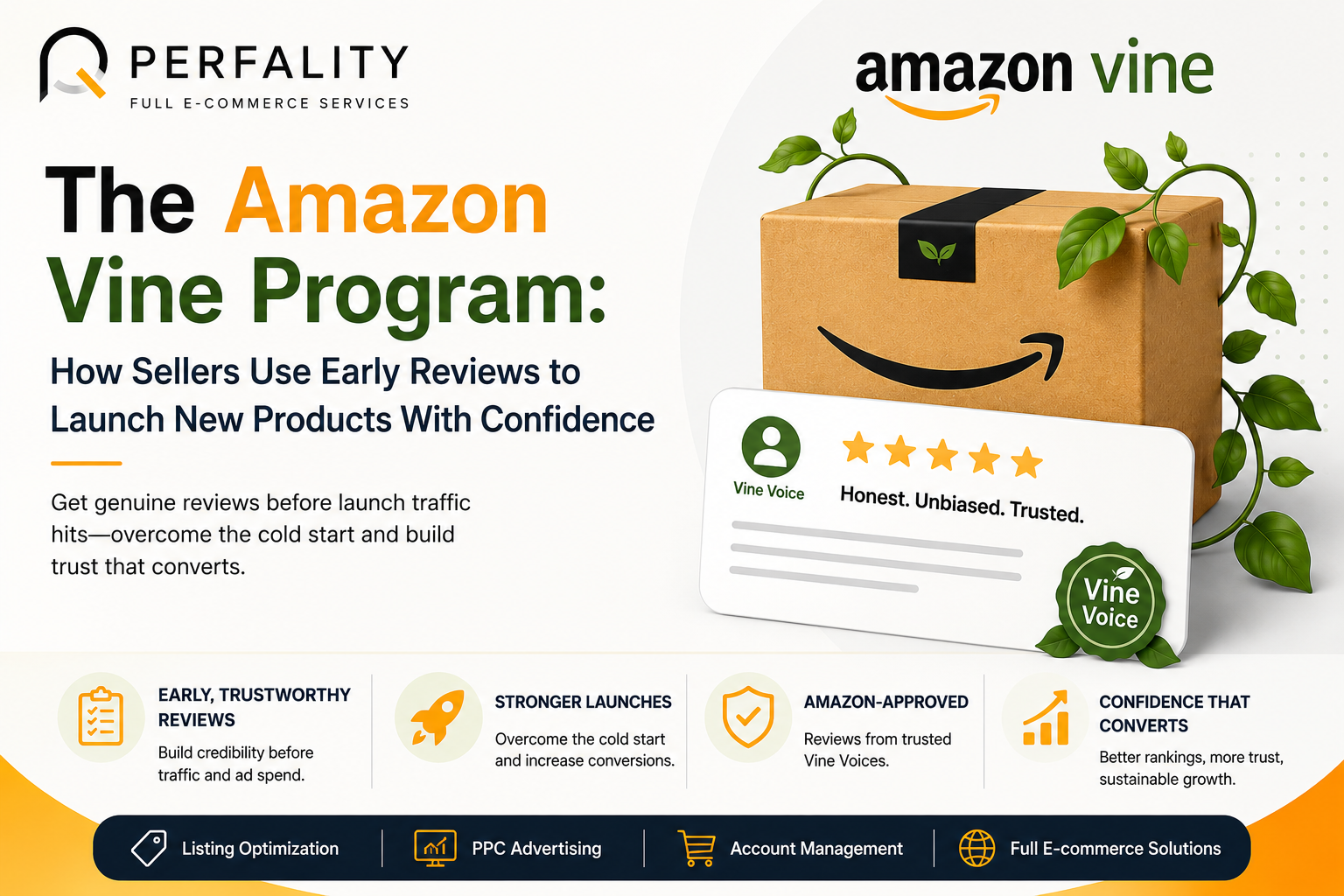
Vine is an invite-only review program run directly by Amazon. It connects Brand Registry-enrolled sellers with a curated group of trusted reviewers, called Vine Voices, who receive products for free in exchange for an honest, unedited review. Every Vine review carries a visible “Vine Voice” badge, and as an Amazon Ecommerce Company that works launches for a living, we watch this pattern play out with nearly every new client: the products that struggle most out of the gate are almost always the ones without any reviews at all.
Vine reviews count toward the listing’s overall star rating and review total just like any other verified review, and they’re indexed and visible to shoppers the moment they publish. What Vine does not do is guarantee a positive outcome — sellers can’t screen who reviews the product, can’t communicate with reviewers, and can’t ask for an edit once a review is live.
Vine Eligibility: What Has to Be True Before You Enroll
Amazon’s eligibility rules touch the seller account, the brand, and the individual ASIN. Before you’ll see the option to enroll, you generally need:
- A Professional Seller account (Individual accounts aren’t eligible)
- Active enrollment in Amazon Brand Registry, which requires a registered trademark
- The ASIN fulfilled through FBA and currently in stock
- Fewer than 30 reviews already on the listing
- An ASIN that has never been enrolled in Vine before — each product only gets one shot, for life
Brand Registry status is table stakes here. Any Amazon FBA Agency helping clients through Vine will tell you the trademark requirement can’t be worked around, so it’s worth starting that process early if a brand isn’t registered yet.
Getting the Listing Ready Before You Submit
Because Vine reviewers judge exactly what’s on the page, a weak listing shows up in the reviews themselves — vague bullets and thin images tend to produce vague, unenthusiastic reviews. This is where Amazon Listing Optimization Services earn their keep before a single Vine unit ships. In practice, that means running a full Amazon Product Listing Optimization Service pass on bullets, images, and backend keywords first, then submitting for enrollment once the page is genuinely ready to be judged. It’s also worth working through a full retail readiness checklist before enrolling, since gaps in images or backend content tend to surface in Vine feedback fastest.
How Enrollment Works, Step by Step
Enrollment is managed in Seller Central under Advertising, then Vine. From there:
- Select the eligible ASIN and choose how many units to enroll, up to the 30-unit maximum
- Confirm the enrollment tier, which determines the fee (more on that below)
- Amazon makes the product available to Vine Voices, who browse and request units they’re interested in
- Vine Voices typically begin claiming units within the first week, and roughly 70% of claimed units go on to produce a published review
- Any units that go unclaimed by the end of the enrollment window return to normal sellable FBA inventory
Coordinating that timeline with inventory, content, and ad launch is exactly the kind of Full Service Amazon Management work that keeps a launch from stalling. Sellers without a dedicated ops team often lean on an Amazon FBA Management Service to track claimed versus unclaimed units daily, since running out of stock mid-window is one of the most common ways a Vine enrollment underperforms.
What Vine Actually Costs
Amazon prices Vine per parent ASIN, on a tiered scale tied to how many units you enroll — roughly free at the smallest tier, scaling up toward $200 for the full 30-unit enrollment. Amazon adjusts these tiers by marketplace fairly often, so always confirm the current fee schedule inside Seller Central before submitting rather than assuming last quarter’s numbers still apply.
A few mechanics matter more than the headline number:
- The fee is charged roughly seven days after the first Vine review publishes — not at enrollment
- If no review publishes within 90 days, the fee is typically waived entirely
- The real cost sits beyond the fee: the cost of goods for up to 30 free units, the FBA fulfillment fees on those units, and any units that go unclaimed and sit in inventory
Many brands time paid traffic to land right after enrollment, using an Amazon PPC Management Service to hold ad spend back until the first reviews publish, since a page with fresh social proof converts paid clicks far better than one with none. A PPC Management Service For Amazon that syncs ad flights to the Vine review window gets more out of every dollar than launching ads and reviews on separate timelines — it’s a sequencing question, and the Best Amazon PPC Management Service providers treat review velocity as a campaign input, not an afterthought.
Vine Reviews vs. Organic Reviews
Vine reviews are permanent — once published, a seller can’t edit or remove them, and the Vine Voice badge stays attached to the review indefinitely. That permanence is the trade-off: honest, credible feedback in exchange for zero control over the outcome. An Amazon Listing Optimization Agency will usually say the same thing we do — reviews fix trust in an already-good page, not weaknesses in a bad one. Pairing Vine with an ongoing Amazon Listing Optimization Service keeps the page improving after the 30-unit window closes, since Vine only ever covers the first stretch of a product’s review history.
Common Mistakes Sellers Make With Vine
- Enrolling before the listing — bullets, images, size chart — is actually finished, wasting the one shot each ASIN gets
- Enrolling more units than available inventory can support, then running out of stock mid-window
- Treating Vine as a guaranteed rating boost instead of an honest feedback channel
- Ignoring what the reviews reveal about the product itself, not just the listing
Sellers without an Amazon Product Listing Service backing them up often enroll before the page is genuinely ready, which burns the ASIN’s only Vine opportunity on a listing that wasn’t done yet. An experienced Amazon Product Listing Service Provider will flag a thin bullet set or a missing size chart before enrollment, not after the reviews start coming in.
Making the Vine Window Work for You
A few habits separate Vine launches that actually move the needle from the ones that just burn a fee:
- Finish the listing first — images, A+ content, and backend keywords all included
- Enroll only as many units as your inventory can comfortably support through the full window
- Fold Vine into the same product launch checklist you’d use for any new ASIN, rather than treating it as a separate side project
- Read every review that comes in for product feedback, not just star count
Working with an Amazon FBA Management Agency to manage inventory through the review window prevents the single most common failure point: running out of stock mid-launch. Brands that already use Best Amazon Account Management Services tend to fold Vine into their existing launch calendar automatically, instead of treating it as a one-off project that falls through the cracks.
How Perfality Helps Brands Launch Smarter With Vine
Perfality works as a Full Service Amazon Agency, which means Vine enrollment gets planned alongside listings, ads, and inventory instead of sitting on its own to-do list. Brands looking for a Best Full-Service Amazon Agency partner often start here, because one team already has visibility into the whole launch. As an Amazon Full Service Agency, we treat the Vine window as a checkpoint, not a finish line, and keep working the listing after the reviews land.
Some clients want a Best Full Service Amazon Agency purely for the FBA side of things; others need a Full Service Amazon Marketing Agency that also runs the ads. Either way, our Amazon FBA Marketing Agency team can plug in wherever the launch needs help. For paid traffic timed to the review window, our Amazon PPC Management Service Agency handles bid and budget pacing so spend ramps up once real social proof exists. And for the listing itself, our Amazon Product Listing Optimisation Service — including Amazon Product Listing Optimisation Service USA coverage for domestic marketplaces — makes sure the page a Vine Voice sees is the strongest version of it.
If you’re comparing options, it’s worth asking any Best Amazon Product Listing Service Agency how they’d sequence Vine against a listing rebuild — the order matters more than most sellers expect. If you’d rather talk it through directly, book a free 30-minute strategy session and we’ll map out whether Vine makes sense for your next launch.