




- Perfality
- September 17, 2026
- 3:35 pm
- Read Time: 10 mintues
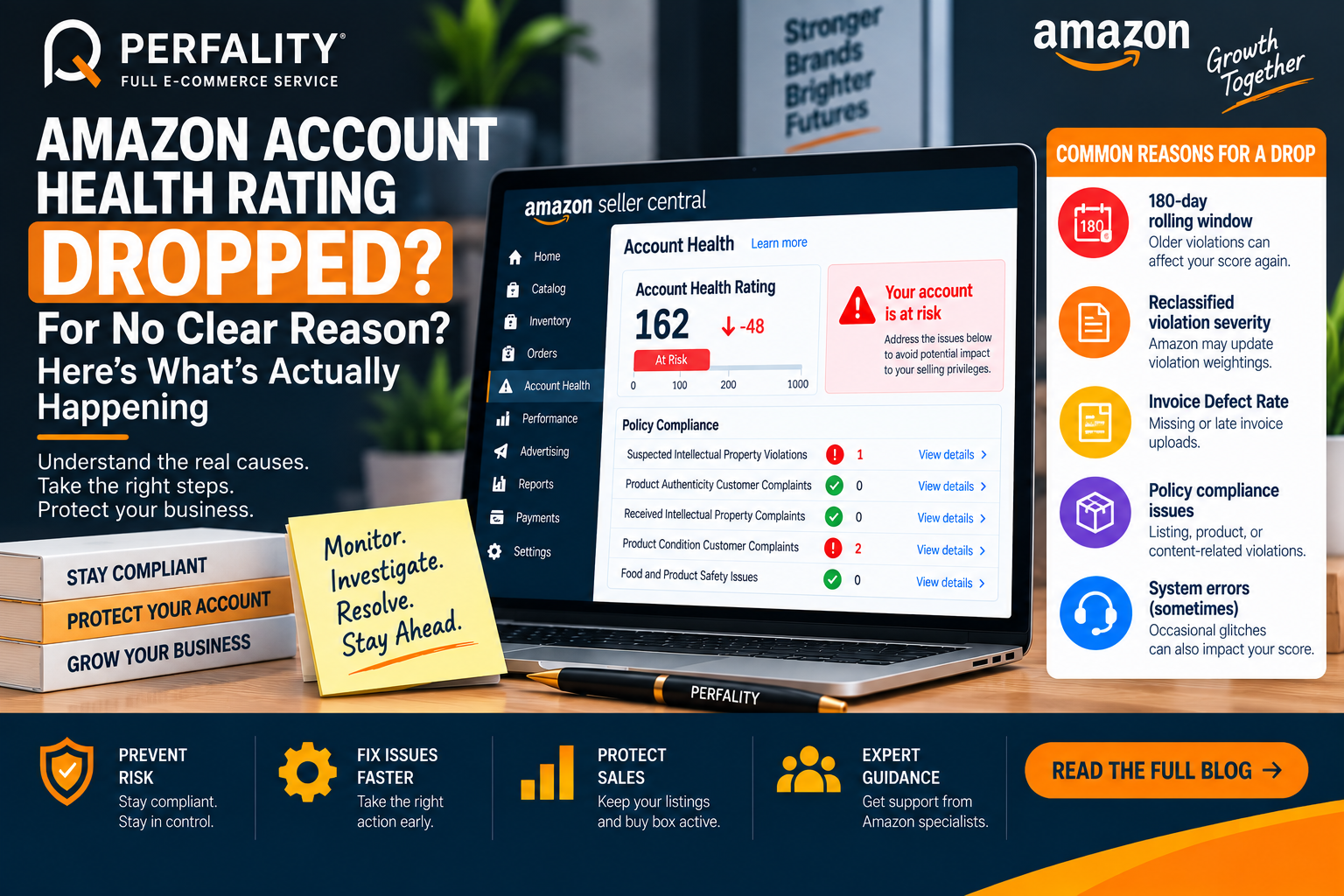
Account Health Rating warnings have a habit of appearing without an intuitive explanation attached. A violation from months ago ages into a new calculation window, a violation gets reclassified in severity, or an Invoice Defect Rate issue has been quietly accumulating in the background — and the score drops with no obvious single cause.
Because AHR runs on a rolling 180-day window and spans more than fifteen policy categories, understanding the mechanics behind a drop matters more than reacting to the warning itself.
Why Amazon Account Health Rating Warnings Feel Unpredictable
- The 180-day rolling window means an older violation can re-enter the current calculation period unexpectedly.
- Amazon periodically reclassifies violation severity, which can shift a score without any new activity on the account.
- Invoice Defect Rate — missing a tax invoice upload within one business day of shipping — is a common, easy-to-miss source of unexpected warnings.
- FBA protects against shipping performance warnings, but not against policy compliance or customer service metrics like Order Defect Rate.
What to Do When a Warning Appears
- Check the Account Health dashboard weekly rather than only after a warning appears.
- Respond to every warning within 48 hours with a Plan of Action that names the root cause, the fix, and the prevention step — vague or partial POAs are the most common reason first appeals fail.
- For Invoice Defect Rate specifically, confirm invoices are uploading automatically rather than relying on manual uploads during high-volume periods.
- Review the violation log carefully if a drop seems disconnected from any real change — occasional system glitches are documented in seller forums, and Account Health Support can investigate.
How Perfality Approaches This
For managed accounts, Account Health monitoring runs as a structured weekly process with a firm response protocol, rather than a reactive scramble once a rating has already dropped. That looks like:
- Scheduled dashboard checks: Account Health is reviewed weekly on a fixed schedule, not only after a warning or rating drop is already visible.
- 48-hour response protocol: every new violation gets a response within 48 hours, since delayed responses are treated by Amazon as a sign the issue isn’t being taken seriously.
- Three-part Plan of Action structure: every POA names the specific root cause of the violation, the exact fix already applied, and the concrete step taken to prevent recurrence — generic language like “we will ensure compliance going forward” is avoided entirely, since it’s exactly the kind of vague appeal that gets rejected on the first attempt.
- Invoice Defect Rate automation check: for this specific violation, we verify invoices are generating automatically at the point of shipment rather than trusting a manual process to be followed consistently during high-volume periods.
- Violation-log review for unexplained drops: if a rating drop seems disconnected from any real account change, the violation log gets reviewed line by line rather than accepting the drop at face value.
Related Services
Account health rarely stays isolated to one metric — a rating drop tends to ripple into buy box eligibility, advertising eligibility, and overall account standing all at once. That’s exactly why it works best as a weekly operational checkpoint handled by whoever already has visibility into the rest of the account, rather than a fire drill someone gets pulled into only after a warning already landed.
Depending on how you’re searching, this kind of support is also known by these names:
- Full-service Amazon management: Full Service Amazon Management, Full Service Amazon Agency, Amazon Full Service Agency, Full Service Amazon Marketing Agency, Best Full-Service Amazon Agency, Best Full Service Amazon Agency
- FBA-focused support: Amazon FBA Management Agency, Amazon FBA Agency, Amazon FBA Marketing Agency, Amazon FBA Management Service
- Listing and content optimization: Amazon Listing Optimization Services, Amazon Listing Optimization Agency, Amazon Listing Optimization Service, Amazon Product Listing Optimization Service, Amazon Product Listing Optimisation Service, Amazon Product Listing Optimisation Service USA
- Product listing services: Amazon Product Listing Service, Amazon Product Listing Service Provider, Best Amazon Product Listing Service Agency
- PPC and advertising management: Amazon PPC Management Service, Amazon PPC Management Service Agency, Best Amazon PPC Management Service, PPC Management Service For Amazon
- Account management: Best Amazon Account Management Services, Amazon Ecommerce Company
Frequently Asked Questions
Account Health Rating runs on a rolling 180-day window, meaning a violation can affect the score for up to six months before it ages out of the calculation.
A strong Plan of Action names the specific root cause of the violation, the exact fix already applied, and a concrete step to prevent recurrence. Generic statements without these specifics are the most common reason appeals get rejected.
FBA protects against shipping performance-related warnings, but not against policy compliance issues or customer service metrics like Order Defect Rate, which can still affect Account Health Rating.
If this is a recurring pain point rather than a one-off, it’s usually worth a quick conversation. Book a free 30-minute call with our team and we’ll walk through what’s actually happening on your account.
Have any questions? Let’s connect!