




- Perfality
- July 31, 2026
- 5:54 pm
- Read Time: 10 mintues
Amazon Business for sellers just hit a real growth marker. The B2B side of Amazon’s marketplace now actively serves over 8 million organizations worldwide, according to Amazon’s own July 2026 company update. For any Amazon FBA Management Agency working across FBA and FBM catalogs, this is the kind of platform-level shift worth building into next quarter’s plan — not just a stat to skim past.
Amazon Business Just Crossed a Major Growth Milestone
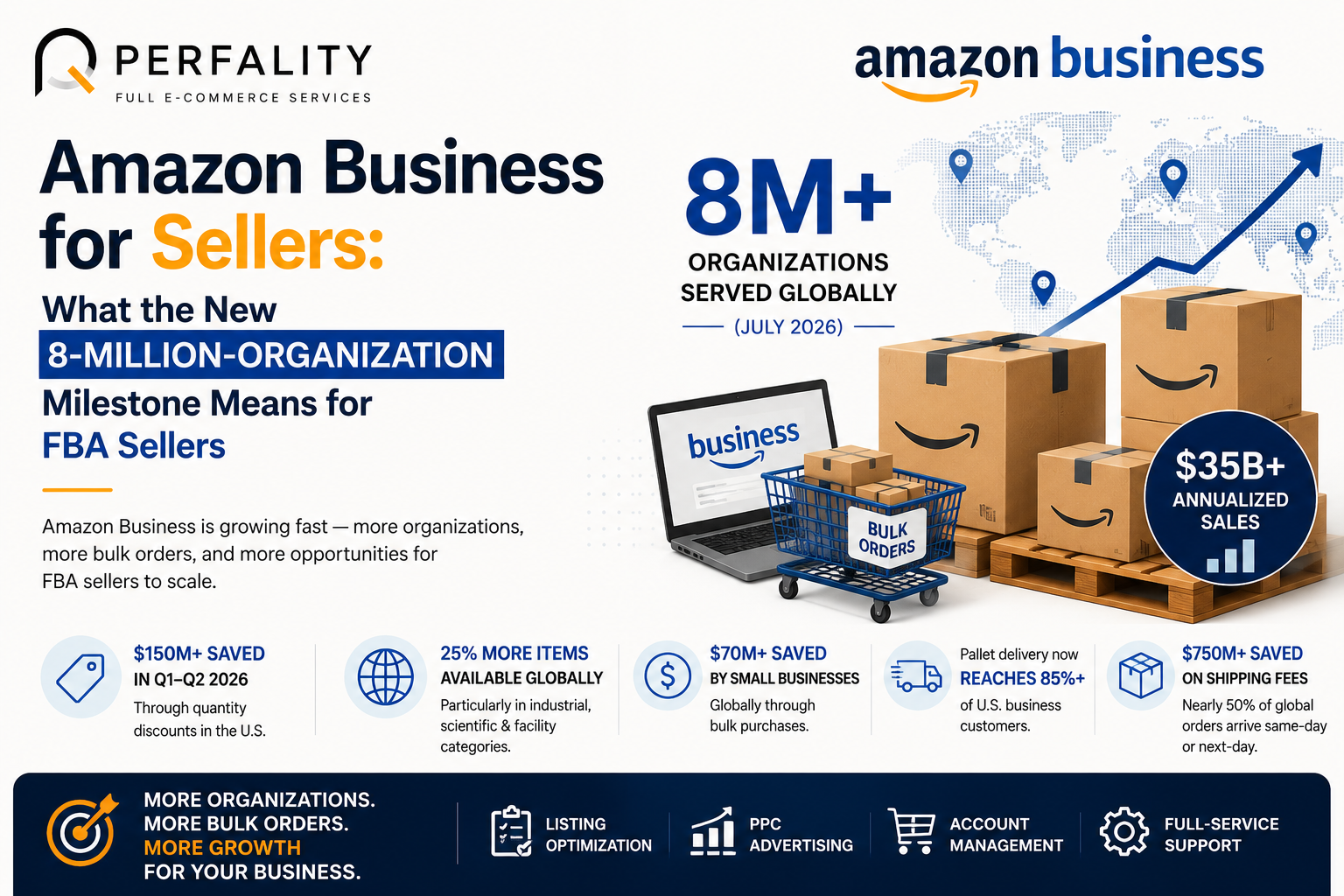
Amazon Business launched in 2015 to serve organizations buying office supplies and other items in bulk. Ten years in, it now drives more than $35 billion in annualized sales and actively serves over 8 million organizations globally, excluding emerging markets — from small businesses to 97 of the Fortune 100.
Doug Herrington, CEO of Amazon Worldwide Stores, said the team is still “committed to the long-term success” of the businesses it serves, with more iteration planned. For sellers, that framing matters: Amazon Business isn’t a side project inside the company, it’s a growth priority, and growth priorities tend to get more seller-facing tools over time.
What’s Changed for Sellers Since Last Year
A few of the numbers Amazon shared are directly relevant to anyone managing a catalog:
- Quantity discounts helped U.S. organizations save over $150 million in the first half of 2026 alone.
- Business buyers now have access to 25% more items globally than this time last year, with particular growth in industrial, scientific, and facility-maintenance categories.
- Small-business customers saved more than $70 million globally (and over $25 million in the U.S.) by purchasing in bulk last year.
- Direct pallet delivery has expanded to more than 85% of U.S. business customers, reducing packaging waste and delivery trips.
Prime Business members saved over $750 million in shipping fees globally last year, with nearly 50% of global orders now arriving same-day or next-day.
Why Bulk Demand Matters for Your Catalog
More organizations shopping through Amazon Business means more recurring, higher-quantity orders sitting behind a slightly different buying pattern than a typical retail shopper. Sellers who’ve never touched business pricing tend to miss this demand entirely, even when their products are a natural fit for offices, clinics, or facilities. A quick catalog review through e-commerce management solutions is usually the fastest way to see which ASINs already qualify.
What This Means for Amazon FBA Sellers
For third-party sellers, Amazon Business is effectively a second demand channel sitting on top of the regular storefront — one built around verified business buyers who often place larger, repeat orders. As that buyer base grows past 8 million organizations, sellers who haven’t set up business pricing are leaving volume on the table.
Working with an Amazon FBA Agency or an Amazon FBA Marketing Agency can help sellers get the pricing tiers, case-pack sizes, and compliance details right the first time, rather than guessing at what a procurement buyer actually needs to see on a listing.
- Enable business pricing and quantity discounts on any ASIN that makes sense for bulk or repeat ordering.
- Audit listings with Amazon Listing Optimization Services so specs, certifications, and case-pack details are visible — institutional buyers read differently than retail shoppers.
Have your Amazon Product Listing Service partner review bullet points and A+ content specifically for a B2B audience, not just consumer intent.
Coordinate with your PPC Management Service for Amazon to test a small, business-buyer-focused ad campaign before Q4 volume hits.
Where a Full-Service Partner Helps
This is exactly the kind of shift a Full Service Amazon Agency should already be tracking on a client’s behalf. As a Full Service Amazon Management partner, Perfality treats an update like this as a cue to revisit pricing tiers now, rather than waiting for Q4 to notice the gap. Brands comparing the Best Full-Service Amazon Agency options typically start with the same first step: an audit of which SKUs qualify for Amazon Business pricing, followed by a pass from an Amazon Listing Optimization Agency to make sure specs and certifications are actually visible to institutional buyers.
Whether you’re vetting the Best Amazon Account Management Services on the market or looking for an Amazon FBA Management Service for the first time, the same question applies: does your current setup even know Amazon Business exists as a channel? Most catalogs we review at Perfality, an Amazon Ecommerce Company built around full-service support, haven’t touched it.
How Perfality Would Approach This
If we were advising a mid-size FBA seller today, the play would be simple: don’t wait for Q4 to look at Amazon Business eligibility. As a Full Service Amazon Marketing Agency, our first move would be a 20-minute pricing-tier audit across the catalog, followed by handing qualifying ASINs to our Amazon Product Listing Optimization Service team to adjust bullet points and A+ content around business-buyer needs. From there, our Amazon PPC Management Service Agency would run one small B2B-focused test campaign this quarter — cheap to try, and it tells you fast whether the demand is really there for your category.
We’d rather a seller test this now, on a small scale, than discover in November that a competitor already owns the business-buyer share of a category.
Key Takeaways for Sellers Ahead of Q4
- Amazon Business now serves over 8 million organizations globally — a growing, recurring demand channel most sellers underuse.
- Quantity discounts and pallet delivery are the two levers Amazon highlighted as driving the most seller-relevant growth this year.
Whether you need the Best Amazon PPC Management Service for a B2B test campaign, or an Amazon Product Listing Service Provider to rework specs for institutional buyers, the Best Amazon Product Listing Service Agency approach is the same: audit first, then act on what qualifies.
If your team is comparing an Amazon Product Listing Optimisation Service USA-wide versus building this in-house, the fastest way to know which makes sense is a short conversation about what’s already in your catalog.
If you want a second set of eyes on your Amazon Business pricing setup before Q4 hits, book a 30-minute call with our team.