



- Perfality
- October 26, 2026
- 6:07 pm
- Read Time: 10 mintues
Most sellers ask about Target Plus fees in the first five minutes, and most get a partial answer. The referral rate is only one line in the budget. Integration software, insurance, shipping, returns and marketing all take a share of every sale, and they decide whether the channel makes money.
This guide lists the seven costs we would budget before launch, shows a fictional per-unit margin and explains how the Target Plus commission changes the result. Target’s seller agreement is not public, so every rate below comes from third-party seller guides and should be treated as an estimate. Ask Target for current numbers before you build a forecast.
Why Target Plus Fees Are Hard to Pin Down
Target Plus is invite-only, and the terms are shared with approved sellers, not published on a public rate card. That is why Target Plus fees look different in every guide you read. Some sources give a single range, others give category rates and a few mention nothing at all.
Seller guides generally describe a referral fee that varies by category, often reported somewhere between the mid single digits and the mid teens as a percentage of the sale. They also say there is no monthly subscription charge, though you should confirm that in your own agreement. Treat both statements as reported, not guaranteed.
The practical lesson about Target Plus fees is simple. Do not build a plan around one number. Build a model where the Target Plus commission can move up or down by a few points and see whether the product still earns a profit.
The 7 Costs Behind Target Plus Fees
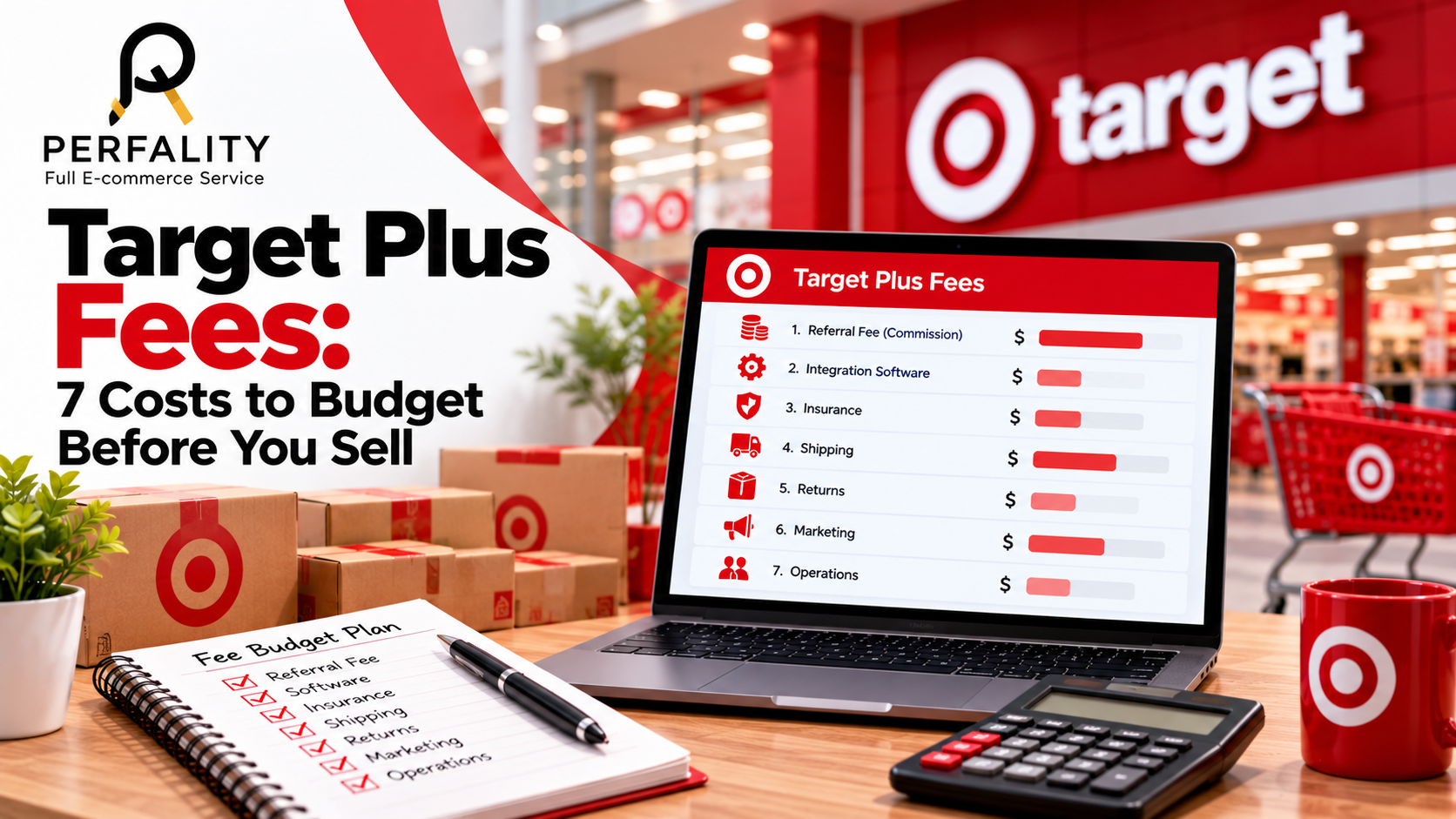
Think of Target Plus fees as a stack, not a single charge, and count every layer of the Target Plus fees stack. Some items are paid to Target, some to partners and some to carriers. The table shows the stack and who normally receives each payment.
Cost | Paid to | What drives it |
1. Referral fee | Target | Category and selling price, as set in your agreement |
2. Integration software | Channel partner | Subscription or per-order charges for the connection |
3. Insurance | Insurer | Coverage level, category and sales volume |
4. Shipping | Carrier | Weight, zone and how fast you must deliver |
5. Returns | You | Return rate, return shipping and write-offs |
6. Marketing | Target or agency | Whether you choose to advertise and how much |
7. Operations | Team or partner | Catalog work, order handling and customer service |
Only the first line is the Target commission in the narrow sense. The other six are the reason two brands with the same referral rate can post very different profits.
The Target Plus Commission: What We Know
According to third-party seller guides, the Target Plus commission is a percentage of the item price that depends on the category. Higher-margin categories such as apparel or beauty are often described as carrying higher rates than categories like electronics accessories. Guides disagree on exact figures, so use them only as a starting range.
Ask three questions when you get your agreement. Is the rate applied to the item price alone or to the item price plus shipping? Do rates change at certain volumes? And are there minimum fees on low-priced items? These details matter more than the headline percentage.
Integration and partner charges
Sellers connect through an approved channel partner or through EDI. Partners usually charge a subscription, a per-order amount or a share of sales. Add a realistic monthly figure to your plan even if your launch volume is small, because fixed charges hurt most when orders are few.
Insurance and compliance
Guides mention liability insurance with coverage from about $1 million to $5 million depending on category. Premiums vary, so get a quote before launch and spread it across expected unit sales. Regulated goods may also need certifications that carry testing costs.
Shipping, returns and operations
Target orders are described as shipping from your U.S. location with carriers such as UPS, FedEx or USPS, and guides say Amazon or Walmart fulfillment cannot be used for them. Returns are your cost too. Our guide on reducing returns shows how listing accuracy lowers that line.
A Fictional Margin Example Using Target Plus Fees
Here is an illustration, not a forecast. A fictional brand sells a kitchen organizer for $40 on Target Plus. We assume a 12% referral fee to show the math. Your Target Plus fees will differ, so replace each figure with your own.
Per unit | Amount | Note |
Selling price | $40.00 | Item price on Target Plus |
Referral fee at 12% | $4.80 | Assumed for illustration |
Product cost | $14.00 | Landed cost per unit |
Shipping | $6.50 | Average label cost to the customer |
Returns allowance | $1.20 | About 3% of price |
Integration share | $0.80 | Monthly cost spread over units |
Insurance share | $0.30 | Annual premium spread over units |
Marketing | $2.00 | Optional spend per unit |
Profit per unit | $10.40 | A 26% margin on the sale price |
The brand keeps $10.40 of every $40.00 sale. That looks healthy, but notice how little room there is. If the Target commission rose to 15%, the referral fee would be $6.00 and profit would fall to $9.20. A single bad return month could wipe out more.
This is why we model Target Plus fees at three levels: a low, a middle and a high case. If the high case still earns money, the product is safe to launch. If it does not, fix the cost before you list it.
How the Target Plus Commission Changes Your Price
Once you know your Target Plus fees, you can work backwards to a minimum price. Start with product cost, shipping, returns, integration, insurance and marketing. Add your profit target. Then divide by one minus the referral rate, because the fee is taken as a share of the final price.
Using the fictional numbers, costs before the fee are $24.80. If the brand wants $10 of profit, it needs $34.80 left after the fee. At a 12% rate that means a price of about $39.55. At 15% it means about $40.94. Small rate changes move the price by a dollar or more, which is why a margin model should be live, not a one-time spreadsheet.
Watch for price conflicts too. If your product sells for less elsewhere, shoppers may notice, and Target guests expect competitive pricing. Our article on signs your catalog needs optimization covers the data errors that quietly erode margin across channels.
Hidden Costs That Surprise New Sellers
- Catalog preparation: barcodes, titles and images take real hours, whether in-house or outsourced.
- Split shipments: sending one order in two boxes can double the shipping line.
- Cancellations and late shipments: guides describe seller performance targets, and misses can lead to account action, so inventory accuracy has a cost.
- Customer service coverage: someone must answer messages quickly, including weekends if you want strong scores.
- Accounting work: marketplace payouts, adjustments and returns need reconciling every month.
None of these hidden Target Plus fees appear on a rate card, yet each one reduces profit. Add a buffer line of a few percent to your Target Plus fees budget for the unknowns, and review it after your first full quarter.
How Fulfillment Choices Change Target Plus Fees
Where you ship from changes your costs more than most sellers expect. Three common setups lead to very different results, and the right one depends on volume, product size and team skills. The comparison below is general, so adjust it for your own business.
Setup | Cost profile | Best for |
In-house warehouse | Low fixed fees but you carry labor, space and software | Brands with existing capacity and steady volume |
Third-party logistics | Per-order pick, pack and storage charges that rise with volume | Growing brands that want less handling |
Dropship from a supplier | Lower upfront cost but less control of speed and quality | Careful testing of new products, if Target allows it for your category |
None of these is free. A third-party warehouse adds per-order charges that belong in your Target Plus fees model, while an in-house setup adds payroll and rent. Pick the setup that gives you reliable delivery speed first and the lowest cost second, because late orders cost more than a slightly higher fulfillment bill.
Questions to Ask Before You Accept Target Plus Fees
Once you receive terms, read them like a buyer. A short list of questions can save you thousands later, and none of them is rude. Sellers who ask clear questions tend to be seen as serious partners.
- Which categories carry which referral rates, and how often can they change?
- Is the Target Plus commission calculated before or after discounts and promotions?
- Are there fees on returns, refunds or cancelled orders?
- How and when are payouts made, and what is held back for disputes?
- What performance targets apply, and what happens if you miss them?
Write the answers into your cost model right away. A rate that sounds fine can look different once you know it applies to the discounted price, or that refunds are not returned in full. Sellers who skip this step often learn about Target Plus fees from their first payout statement instead of from their plan.
Ask your integration partner the same kind of questions. Find out about setup charges, order limits, extra fees for additional users and the cost of ending the contract. A partner is a long-term cost, and the best ones explain it clearly.
Finally, keep a simple record of every charge you actually pay in the first ninety days. Compare it with your model each month and note the gap. Over time that record becomes your most reliable guide, far better than any guide you read online.
How to Keep Target Plus Fees Under Control
- Pick products that can absorb Target Plus fees. Choose items where the high-fee case still earns a profit.
- Negotiate the integration, not just the rate. Compare partners on fixed charges as well as per-order fees.
- Cut the return rate. Accurate content and sizing information lower returns faster than any discount.
- Track margin by SKU. Know your real Target Plus fees per item. A dashboard built on retail data analytics shows which items actually earn money.
- Review Target Plus fees quarterly. Compare your real costs with the model and adjust prices or products.
- Referral fee range confirmed in your Target agreement
- Integration partner quotes compared on fixed and variable charges
- Insurance quote received and spread across expected units
- Shipping cost modeled by weight and zone
- Return allowance set from past channel data
- Low, middle and high margin cases built for each product
- Minimum price calculated for each SKU
How Perfality Helps You Control Target Plus Fees
Cost control starts before the first order. When we support a Target Plus launch we typically provide:
- A full cost model that goes beyond the Target Plus commission and tests each product at low, middle and high fee cases.
- Catalog cleanup that reduces returns and rework, so you pay for fewer mistakes.
- SKU health monitoring that catches pricing and stock errors early, in the style of our SKU health checks.
- Margin dashboards that show profit by product, not just revenue.
- Day-to-day store handling through our Target Plus marketplace management
The goal is not the lowest fee. It is a channel that earns more than it costs to run.
Related Services
If you want a clear picture of Target Plus fees for your catalog before you apply, our team can help. For the full picture of what we do for sellers and suppliers working with Target, see our Target Plus marketplace management service. Depending on where this issue keeps recurring, this is the kind of support that typically helps:
- Full-service Amazon management: Full Service Amazon Management, Full Service Amazon Agency, Amazon Full Service Agency, Full Service Amazon Marketing Agency, Best Full-Service Amazon Agency, Best Full Service Amazon Agency
- FBA-focused support: Amazon FBA Management Agency, Amazon FBA Agency, Amazon FBA Marketing Agency, Amazon FBA Management Service
- Listing and content optimization: Amazon Listing Optimization Services, Amazon Listing Optimization Agency, Amazon Listing Optimization Service, Amazon Product Listing Optimization Service, Amazon Product Listing Optimisation Service, Amazon Product Listing Optimisation Service USA
- Product listing services: Amazon Product Listing Service, Amazon Product Listing Service Provider, Best Amazon Product Listing Service Agency
- PPC and advertising management: Amazon PPC Management Service, Amazon PPC Management Service Agency, Best Amazon PPC Management Service, PPC Management Service For Amazon
- Account management: Best Amazon Account Management Services, Amazon Ecommerce Company
If this is a recurring pain point rather than a one-off, it’s usually worth a quick conversation. Book a free 30-minute call with our team and we’ll walk through what’s actually happening on your account.
Frequently Asked Questions
Target does not publish a public rate card. Third-party guides describe a category-based referral fee, often reported between the mid single digits and the mid teens, and no monthly subscription. Confirm the exact terms in your Target agreement.
That depends on your agreement. Ask Target whether the Target Plus commission applies to the item price only or to the item price plus shipping, because it changes your margin.
It depends on the category and on what you count. Compare the full stack, including integration, shipping, returns and marketing, before deciding which channel earns more for a given product.
Have any questions? Let’s connect!